
By: Jason Dachman, Editorial Director, U.S., Sports Video Group
May 22, 2026
In its second year as rightsholder, FOX Sports goes bigger across the board for Sunday’s 1080p HDR broadcast: 70+ cameras, 150+ mics, new in-car angles, automated AR graphics, deepening partnership with IMS Productions
The Indianapolis 500 has always been one of the industry’s biggest productions, but, in just its second year as rightsholder, FOX Sports has taken the operation to an entirely new level. From Emmy Award–nominated AR graphics to dynamic new in-car cameras to a sprawling onsite studio presence, this weekend’s 1080p HDR production (distributed in 4K) from Indianapolis Motor Speedway will be among the most technically advanced and resource-rich broadcasts of 2026.
“It’s amazing what a second year brings because we know a lot of the things that were unknowns in year one, and that goes for both operations and production,” says Mike Davies, EVP, technical and field operations, FOX Sports. “Our friends here at IMS Productions have so many years of experience doing this and have guided us through it every step of the way. This year, we’re taking a lot of the cool things we did together last year and scaling them up — whether that’s production elements like the HUD [heads-up display] and the Driver’s Eye or some of the engineering and workflow things happening under the hood.”
Few live events test a broadcast operation like the Indianapolis 500. The numbers alone explain why. The race runs 500 miles, with 33 cars taking 200 laps apiece around a 2.5-mile oval, and the venue that contains it sprawls across 1,000 acres of property. On race day, that footprint holds roughly 350,000 people: about 235,000 in the grandstands, another 100,000 in the Snake Pit infield, and some 12,000 workers keeping the operation running. And don’t forget about the iconic 92-ft. scoring pylon.
“Simply put, [FOX] didn’t know what they didn’t know last year, and it was a brand-new way of doing things for us as well,” says IMS Productions President Kevin Sublette, who will be overseeing his final Indy 500 this weekend after many years at the helm. “It has never been this large in terms of the overall production [operation] before FOX got here, so it definitely took some getting used to, but I think we both have benefited from working together. You’re going to see that in a lot of the things changing from year one that I think will enhance the production.”
70+ Cameras, 100+ Feeds: Cockpit Cams, Crains, Drones
Director Mitch Riggin will have more than 70 cameras to work with and more than 100 video feeds in his monitor wall to produce the show. Although the atmosphere at Indy Motor Speedway provides plenty of unique shot opportunities, it’s the in-car cameras that typically resonate most with fans.
Among the new additions for this year are what FOX is calling “Top Gun” cameras: mini RF cameras in the cockpit that provide a full head-on shot of the driver’s head. Spearheaded by Riggin and developed by NEP Specialty Capture, the Top Gun cameras are inspired by camera angles from both the Tom Cruise naval-aviation classic and modern racing films like F1: The Movie. IMS Productions also worked closely with IndyCar chassis manufacturer Dallara to find the most seamless way to integrate the miniature camera into the car so that it did not impact the driver.
“We took that vision from Mitch and worked with Dallara and [NEP Specialty Capture] to figure out a way to make this work,” says Ken Ferguson, senior director, broadcast operations. FOX Sports. “There were a lot of changes made to the housing and the lens, but I think what they finally came up with brings the viewer right into that cockpit. It’s going to tell the story a lot more because you can see the driver getting ready, setting someone up for a corner, and looking back and forth. It’s a great storytelling position.”
FOX and IMS Productions also worked together to add a new camera near the Buckeye, the round external port on an IndyCar’s rear side where the fuel hose connects during a pit stop. Because IndyCar tracks run in different directions, there’s a fuel port on each side. At Indy, the port on the right-hand side is covered with a flat blank, leaving a void in the bodywork where another onboard camera can be added.
“We’ve always wanted to get a camera in that space,” says Ferguson. “The view from there gets you the rear tire so you really see that moment when they’re fighting for position. You can see the action coming up on them, and it gives you a good view of how close they get to the wall, plus the suspension movement. [NEP Specialty Capture] found a way to plug a camera into that small space.”
The Top Gun and Buckeye camera angles join the Driver’s Eye camera, which has been a hit with fans through FOX’s first two seasons of IndyCar coverage in offering a cockpit view no broadcast could show before. Six of these Racing Force micro-cameras will be mounted in the helmet at the driver’s eye line to provide a look at the driver’s visor, wheel, mirror glances, and hands on the paddles.
With multiple onboard angles per car — roll-hoop forward and rear, the Driver’s Eye, side pod, Buckeye — dozens of feeds must be coordinated by NEP Specialty Capture and FOX.
“This year,” says Sublette, “our partners at [NEP Specialty Capture] have been able to do dual feeds off the car, so we have two live video feeds coming off at all times. We’ve got 17 of those cars this year, and the dual-feed capability makes a huge difference in terms of what [camera angles are] available to Mitch in the truck.”
FOX has also rolled out 10 high-frame-rate Sony cameras running at 240 fps (4X super-slo-mo), while IMS manages all the robotic camera systems in-house.
A total of 14 RF handhelds and BSI pit-box cams from NEP Specialty Capture will be roaming the garages, the grid, and pit lane — free to follow the action wherever it goes.
Up above, FOX will have three drones and a helicopter providing aerial coverage all weekend.
Beverly Hills Aerials is providing all three drones — one more than last year — to provide broadcast-wide, mid-range, low FPV chase coverage.
“We had two drones last year, and we liked them so much that we thought we could use another one,” says Davies. “It’s helping us, especially for the pre-race, where we’re able to divide and conquer some of the ceremony and pageantry. Brian Lilly, our pre-race director, uses them quite a bit to find the different areas of the track, because we’re spread out quite a bit.”
Other key angles include a 38-ft. Technocrane (Camera 66) that is shared with the studio show and will provide sweeping views of the front stretch for opening shots and AR takeovers. Mobile Scorpio Telescoping Cranes is on hand with telescoping arms on carts to deliver fluid, sweeping moves through pit boxes, the grid, and victory lane.
A full arsenal of state-of-the-art telephoto lenses will be deployed to sweep the full front straight and show cars coming home from a half mile out — all framed tight in one shot.
For replay, five EVS XT-VIA production servers will offer FOX’s replay team more than 30 iso channels to capture key moments via replay.
AR Graphics: The HUD, Ghost Car, Optical Pointers, and More
After a successful debut last year, FOX’s AR graphics team is looking to push storytelling and visualization even further. From Ghost Car Live to expanded telemetry graphics and virtual race enhancements, FOX has teamed with Mobii and SMT to make the speed, strategy and precision of the Indianapolis 500 more accessible and engaging for viewers.
“We’ve focused on our suite of augmented-reality products for the in-car cameras,” says Zac Fields, SVP, graphic technology and integration, FOX Sports. “When we acquired Indy, we wanted to push the sport forward and give it a lot of production value. Outside of just adding cameras, we focused on two ways to accomplish that: adding data that feels organic in the traditional in-car camera with the heads-up display and keeping the data in place as the in-car cameras pan, tilt, and move around.”
The HUD virtual graphic will once again provide viewers with a look at key telemetry (throttle, brake, gear, speed), the car’s position on the track, and distance to the car in front when it counts. Keyed onto the in-car feed and onto the Driver’s Eye camera, the HUD creates an Iron Man–like overlay in which the viewer can see every data point the driver reads.
“The heads-up display is achieved with a lot of machine learning through our partners at Mobii,” Fields explains. “They take in the in-car footage and train the model so that, if the camera pans, the graphic stays in place. That allows us not only to integrate data with the in-car camera but also to put visuals around the tires, the car next to it, the car behind it — and it all stays in place. The augmented reality is the part that makes it feel a lot more organic.
To further complicate matters, FOX is handling all these feeds simultaneously — taking 17 cars with in-car cameras, applying the graphic and the tracking, and automatically outputting it for every single in-car. This means that, each time a HUD is added for an in-car camera, another source is added for the router — and it can total up quickly.
“The beauty of it, though, is that it’s now automatic,” says Fields. “The director doesn’t have to worry about the graphics or coordinate them. It’s a much more seamless delivery.”
Davies adds, “The heads-up display turns an in-car camera into a data source, so you can watch the race from an in-car camera and not miss all that much. When you layer on the pointers, the track map, and all those [graphics], you’re now riding along with the driver and have a truly data-driven point of view. That came out of Formula 1 and is transforming the way we shoot the race. We’re up about 30% in time on-screen for in-car cameras, which is amazing to think about.”
During Indy 500 qualifying weekend, SMT’s Ghost Car Live technology also allowed viewers to compare drivers in real time. Ghost Car Live 2.0, the Mario Kart–style live application, builds on SMT’s original Ghost Car platform — which debuted on NASCAR in 2018 — and introduced real-time virtual car comparisons overlaid directly into live in-car video. Traditional Ghost Car comparisons and live wind graphics were also featured throughout qualifying coverage.
“We wanted to create more suspense around who a driver is chasing, so we looked at ways to superimpose the car they’re chasing in a ghosted format to illustrate that to the viewer,” says Fields. “We worked with our friends at SMT, who have the technology to incorporate this via GPS vectors in the cars. SMT manages that entire system by essentially merging the data on where the car is on the track with the location of the car in front of it, and they’re able to superimpose it. You get that effect of chasing the leader or chasing a different car, in a timed instance.”
This year, for the first time, FOX is able to couple the HUD graphic with the Ghost Car technology.
“Those two ideas are the suite of products that we think have changed the way we produce racing,” says Fields. “You’re seeing that right now with the amount of use we’re getting out of the in-cars and the Ghost Car. It has grown tremendously, not only in the tracking technology but in how we’re able to automate the process. We can combine the HUD with the Ghost Car and do multiple boxes with the HUD and Driver’s Eye. In the past, that would have been extremely difficult to coordinate, but now it’s second nature.”
SMT is also providing instrumented and optical pointer graphics to highlight key moments and battles throughout the race. The optical pointers are calibrated to the live broadcast in order to identify every car on the track in real time. This allows the FOX graphics team to display car numbers, gaps, positions, and threats — all frame-locked to the action as the field reshuffles lap by lap.
Other key AR graphics built in-house by the FOX Sports Creative team using Unreal Engine will include pylon takeovers, a digital twin of the Speedway, and graphics that grow out of the track and lay over the front stretch.
In addition to the pointer graphics, SMT is also introducing several enhancements to FOX Sports’ race presentation, including virtual graphics displaying live lap numbers and flag status directly on the racing surface. Additionally, SMT is supplying track-map integration for FOX and Indianapolis Motor Speedway, full data provisioning for the FOX Box and FOX graphics engines, and data services for FOX production prompters. SMT will also provide a new leaderboard and pointer package for Friday’s second-annual Oscar Mayer Wienie 500.
“Scale is where you’re seeing us make headway this season, even more so in the Indy 500,” adds Fields. “The HUD, Ghost Car, overlaid graphics on the Driver’s Eye to create that Iron Man display — that is all automated now. And you’re seeing those [elements] woven into the broadcast. We’re also starting to do AR with our drones over the track, and you’ll see a good amount of that in Indy. Now that we have that foundation and automation, it makes things a lot easier.”
More Than Just the Roar: 150+ Mics, Stereo Sound From Every Cockpit
On the audio side, FOX’s 5.1-surround-sound broadcast will rely on more than 150 mics scattered throughout the IMS campus. The roar of the crowd will be captured by dozens of microphones around the oval, and two mics on every car — left and right — will deliver full stereo sound from each IndyCar vehicle. To mix the show, FOX Sports, which is known for prioritizing audio and earned three of this year’s five Sports Emmy nominations in Outstanding Sports Audio/Sound – Live Event category, has enlisted four All-Star audio engineers, all of whom have worked Indy as well as Super Bowls, NASCAR, and college football.
“Last year, we had just a single mic on the cars for mono audio,” says George Grill, field technical producer, FOX Sports. “It always sounded great, but it didn’t quite give us what we needed. When we tried dual mics and did stereo audio, we found that you could actually hear cars coming up fast and tell whether they were on the right or left, just by where the audio was coming from.
“The prevailing wisdom,” he adds, “was that you just put the mic by the engine and listen to that loud roar. Actually, the further you get from the engine, the more of the subtle, detailed sounds you are able to get. We pushed [the mics] more into the nose of the car, away from the motor, to eliminate the constant engine sound. That’s where you start to hear more of what’s going on on the track.”
Going Big on Onsite Studio: Four Sets, Cine Cameras, Gronk in the Snake Pit
FOX Sports has significantly beefed up its onsite studio presence this year in Indy with four pre-Race Stages strewn throughout the IMS campus. The main set will be on the track with another located at the Pagoda. A FOX Big Noon Kickoff–style outdoor set has been erected at Pagoda Plaza, and legendary NFL player Rob Gronkowski will lead coverage from a set positioned inside the always raucous Snake Pit infield.
In addition, FOX will have its army of on-air talent positions set up in the main announce booth, pit lane, the grid, and the garages, with additional reporters roaming the grounds.
“FOX’s pregame footprint is much bigger this year,” notes Rod Conti, SVP, studio remote operations, FOX Sports. “[We have] not only FOX Sports but also FOX News and our digital team here. Weather permitting, we have a great new set right in the center of the track [in the infield], where we’re looking to cover the concerts and craziness going on there. That was fun last year, and we are looking for more this year.”
In a major development, FOX Sports has teamed up with broadcast-production–tech supplier The HELM to deploy more than 10 ARRI ALEXA 35 Live cameras across its four Indy 500 sets. ARRI’s new multi-cam system brings cinematic 4.6K image quality, HDR, and creative control to live productions in a dockable multi-camera setup.
“Normally in my [remote-studio] world,” says Conti, “the background is the most important thing so you can see crowds and scenic. Shallow–depth-of-field cameras usually aren’t our thing because they blur out the background. But, when we test these, we have so much range, and the colorimetry is so fantastic that they almost offer a 3D feel. It gives us a lot to play with and provides us with the versatility to get the look and feel you want at any given moment.”
A few minor issues with the ARRI ALEXA 35 Live cameras were identified and remedied early on: for one thing, The Helm put the system in a proper live-production–friendly casing. The ARRI Live production system also has a CCU in the back, so that it can be integrated directly with the truck like a standard broadcast camera. The camera body looks and handles similarly to a standard broadcast camera — with full connectivity, buttons, and returns — facilitating its use by any operator.
“We’re all pretty impressed with that look, and I think you’re going to see it a lot more in the future,” says Rob Mikulicka, director, operations, remote studio, FOX Sports. “We’ll be using [ARRI ALEXA 35 Live cameras] as our go-to cameras on the sets so you’ll be seeing that look during our shows. [From a workflow standpoint], they’ve pretty much dropped in with no problem thanks to The HELM.”
In the Compound: IMS HD-5, GCV Ovation, Month-Long Production Village
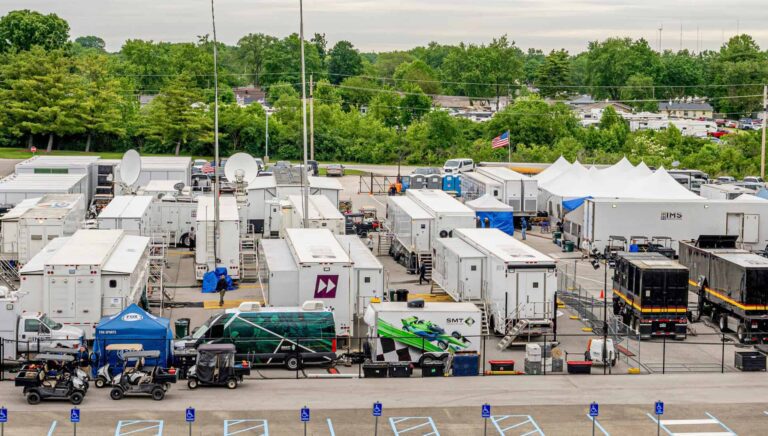
The production compound located just outside Turn 4 in the NW Lot off Cagle Lane is packed with a dozen mobile units headlined by IMS HD-5, Game Creek Video Ovation, and NEP Specialty Capture’s RF unit.
While this weekend marks peak activity inside the compound, the production village has actually been up and running throughout the entire Month of May to accommodate practice, qualifying, Carb Day, and race day.
IMS HD-5, which underwent a full-IP rebuild prior to last year’s race, is once again at the core of the race production. Featuring a Grass Valley switcher, Sony HDR monitoring, and Cisco IP fabric, the mobile unit will serve as home to FOX’s 1080p HDR production.
“We made a few upgrades over the winter,” says Jason King, senior director, engineering, IMS Productions, “but, for the larger part, we converted the truck to IP last year, so the core hasn’t changed as much. There is absolutely no way we could have done this show last year with a baseband router. Even with the upgrade, we’re still filling up fast and always looking for more [router space]. We invested heavily in the truck in the first year, and, this past offseason, we invested even more — and we’ve already outgrown a lot of that. It just grows and grows, which is great because that’s exactly what we want.”
Game Creek Ovation, FOX Sports’ flagship truck and home to FOX’s NFL A-game production last season, will serve the various studio-show productions taking place onsite. The ST 2110 IP mobile unit is equipped with HDR monitoring and the latest Riedel intercom system and powers the 10-plus ARRI live-cinema cameras being used across the four stages.
“It has been a huge luxury to have all that firepower and extra room with [Ovation] here,” says Matt Battaglia, director, remote engineering, FOX Sports. “We’re using it not just for the studio shows but also for overflow from the race. We have some replay, shading, submix, subswitching, and all kinds of things going on there.”
NEP Specialty Capture’s RF unit will handle all wireless cameras and talent mics and manage the complex RF coordination. Infinite Structures has constructed temporary offices and meeting space for the production/operations crew and FOX executives onsite.
The broadcast compound and remote sets draw on roughly 2 MW of power, supplied by CES Power primary and backup generators at the compound — paired with a large UPS for clean, uninterrupted power — along with additional generators staged inside the oval to run the pregame sets independently.
More than 20 miles of fiber connects it all together around the Speedway, and 10+ transmission paths (via Lumen) are being used for contribution.
Between FOX Sports and IMS Productions, roughly 200 people work the show onsite: producers, directors, engineers, camera operators, audio mixers, technicians, and talent handpicked from across the country and around the globe. Some of them have ridden with the INDYCAR tour for decades; others fly in just for this race, which assembles the seminal motorsports crew at the Brickyard one weekend a year.
FOX Sports, IMS Productions Settle Into Deepening Partnership
A year into the working relationship, FOX Sports and IMS Productions have moved from cautious coordination to something closer to a single unit at the Indianapolis 500 — a shift both sides credit to experience, added resources, and a shared sensibility.
“Last year, we planned and had meeting after meeting after meeting,” says Ferguson. “It’s hard to describe what the weeks leading up to the race and race day itself are like [at a facility where cars run six hours a day during practice]. This year, we’re humming compared to last year.”
The operational integration has become literal. FOX’s ownership stake in IMS Productions — following Roger Penske’s investment in the property — has brought the two groups into a tighter whole. “Last year was a partnership; then we became owners,” says Sublette. “There’s a feeling in the compound that we’re all one big family.”
He notes that the operational sides have combined into a single trailer to communicate more effectively. “FOX has been an incredible partner and owner, and the partnership continues to grow.”
Says Davies, “Coming in, we didn’t know what it was going to be like to work with these guys and vice versa for them, but I could not envision a more productive partnership. The reason is that we’re serious about what we do but we don’t take things too seriously. We allow ourselves to be passionate, to have some fun, but to always keep the focus on our common goal. It has been an amazing partnership, and we already can’t wait for next year.”