
By: Jason Dachman, Editorial Director, U.S., Sports Video Group
May 22, 2026
The broadcaster is drawing on lessons learned in its first year of covering the race
Heading into FOX Sports’ second Indianapolis 500, Lead Director Mitch Riggin discusses what changes have been made, the camera arsenal he’s deploying, and the challenge of cutting a race he likens to following four footballs at once. Check out SVG’s full coverage of the 2026 Indy 500 HERE.
This is your second Indy 500 with FOX. How does the production feel different?
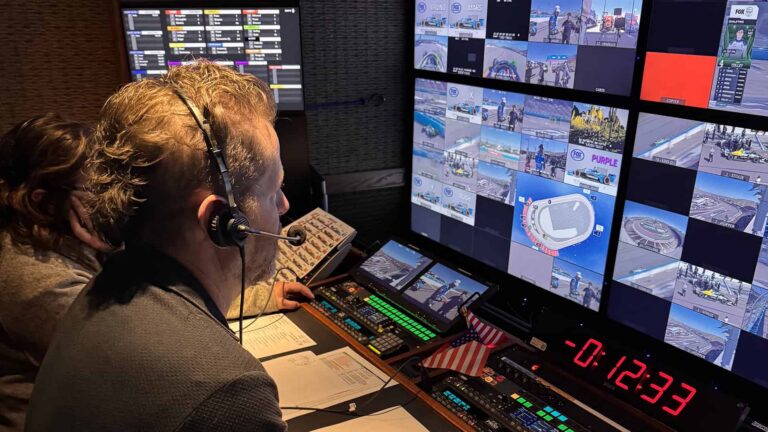
Last year, a lot of us didn’t know what we didn’t know. Now at least I know what I don’t know, and that’s a big advantage. There are simple things, like laying out a monitor wall. I don’t get all my cameras up until Friday, so just knowing to anticipate that helps. I have 22 operated cameras, plus all my in-car cameras — basically, 30 paths — and each in-car has three or four cars. So you’re talking more than 70 cameras; then I add another 25 to 30 operated cameras.
With that many feeds, how do you keep track of everything on race day?
I renumbered the cameras this year so I can immediately find what I need. On race day, when you’ve got a hundred cameras and the cars are on the track, you have to know where to look immediately.
You grew up in Indianapolis. What does this event mean to you personally?
I grew up here until I was 13, so it was pretty cool. As a kid, I always came out; I never went to the race, but I always went to practice and qualifying. [Now] I actually came out a day early just to go to the museum because they just updated it. I saw some kids on a field trip, and it brought it all back.
Looking back at year one, what went well?
Our implementation of technology. FOX Sports President Eric Shanks grew up in Indy, so this is a passion project for him. He has been great — it’s “Hey, what do we need?” — so he has enabled us to throw a lot of tech at this, adding the ghost car, the Mario Kart, the drones. The drones, to me, were some of the biggest things we were able to do.
A lot of your crew came from other sports. How steep was the learning curve?
A lot of us in this truck hadn’t done much auto racing before. I’d done none. I’ve been with FOX since 1997, first as a technician and then directing in the early 2000s, so I know the FOX attitude, as we call it. For me, it was learning how to cut auto racing. FOX has always been good at eventizing things, and I think we did that well in the 500. Now it’s about getting to the nitty-gritty, incorporating things at the right time and knowing what’s going on at the track.
How would you describe that challenge to someone outside the sport?
Somebody once equated it to doing a football game with four footballs. You’re following one, it’s cool, and then all of a sudden there are four footballs on the field — this one’s going for a first down, this one’s second, this one’s a running situation. Trying to plan for that is what auto racing is like.
Let’s talk cameras. What’s changed with the in-car package?
I had only 16 paths last year. This year, we’re doing 17 cars, and I have dual paths on all 17. The plan is to keep the top roll-hoop camera up on one path and mess around with the other. Sometimes, those roll-hoop cameras go down because they get broken, so we adapt. On the other path, we can choose from a driver’s-eye view and more.
One of the new looks is the Top Gun camera. What is it?
It’s a little different from the driver’s-face camera. With the old camera, you could see the driver’s helmet. Our new look lets you see a bit of the steering wheel and off the sides of the windows. I lowered it and made it more straight-on, so you can actually see what the driver is doing. We got nominated for an engineering award for it, and we’ll find out tomorrow if we win.
What else is new in the camera arsenal?
I’m doing another one we call the Buckeye camera. On the car, [there is a fuel port] called the Buckeye, so we may rename [the camera]. Eric joked, “We’re calling it the Buckeye camera in Indiana.” I’ve got six cars with it. It’s on the outside, looking backward, so, on the ovals, you’ll see some cool fan shots: how close they get to the wall, passes on the outside. I’ve got six driver’s eyes, six Buckeyes, and five face cameras recording at all times. That’s 34. In certain situations we rotate around, especially at the start.
You leaned heavily on drones in year one. What’s the plan this time?
We’re adding a drone, so we’ll have three plus the helicopter. We’ve broken the track into three parts, plus the pits and some color. The drones give a more cinematic look. This is such a high-speed race that it’s more about racing coverage. Down the back stretch, when the cars are coming at you, it really gives you a sense of speed. We named them Buzz, Dart, and Drone.
How low can you actually fly them around moving cars?
I’ve worked with the drivers and IndyCar on this. I talked to [driver] Pato O’Ward and several others, and they’re fine with it. I always do it in practice. Last year, after the helicopters flew around, I got permission during the parade lap to drop the drones about 6 ft. off the ground — the cars are coming right at you, going slow, three wide. There’s a lot of coordination: helicopters come in, drones go down, helicopters go out, drones come back up.
How do you manage the safety side?
Safety is the number-one thing. When I first used a lot of drones in the UFL, I’d always say, “If I ask you to do something that’s not safe, I can’t see where you are. You can. Please don’t do it; I’ll understand.” Same thing here. Even though a couple of drivers said the aeroscreen would protect them, they said, “We don’t want to go there.”
What about specialty cameras around the facility?
We’ve got technocranes, jibs, and spider cams. We have a technocrane out with the Gronk Cam, dedicated to [legendary NFL player Rob Gronkowski], at the Snake Pit. I’ve been told to be careful taking that shot live because you might get something you don’t want, so I tend to run it off tape; they call it the Snake Pit for a reason. That’s Camera 38. There’s a combination of five jibs, technos, and spider cams here. Some are for the pre-race show, which Brian Lilly directs, and then I move them during the race.
How do you and Brian coordinate the handoff from the pre-show?
Brian goes up through “God Bless America,” we go to a commercial break, and I pick it up with “Back Home Again in Indiana,” then go through “Drivers, start your engines.” There’s a lot of work to make sure we have fiber to these places: one of those cranes goes from the front stretch back to Turn 3, another goes out to Turn 2 on a big arm.
What’s a specific lesson from year one you’re applying now?
Last year, I put a couple of cameras on my monitor wall in the wrong spot. I thought, “Okay, I’ll remember to look down there.” I think I used one of them once. Those are the things you learn: that needs to be up here, not down over there. Being in year two helps with that.
How is the wireless RF package built out?
We’ve got a Steadicam, a Megalodon, and five RF handhelds. I share one with the pre-race show, but the other four are ours. Typically, on a weekend, I have three, so we added two more. Each reporter has their own RF. I’ll plan for one to roam: go to the Pagoda, get embedded with cars coming by from a fan’s perspective. The other three are with our reporters and help on pit stops.
You’re working alongside technicians who’ve been at this track for decades. What have you taken from them?
A couple of camera operators have been here over 30 years — I think 32 with Eddie is the most. That first year, those guys were great. I learned a lot, asking, “Hey, what should I be doing here?” Now I have a philosophy and can implement things I want to do. But this couldn’t have happened without relying on technicians carrying on this tradition. These guys are from Indiana and understand there’s a lot of civic pride in doing this.
Is the RoverCam back this year?
We thought it was cool, but we’d rather have the drones. You have only so many resources, so it’s about how to allocate the money. We may bring it back at some point. People are always trying to sell us on ideas, and, at FOX, we’re always willing to take a look. We’re going to share that other drone a little with IMS, one of our partners, for their pre-race show. That was one of the reasons I wanted to add it.
Of all the technology since FOX took over, which camera has made the biggest difference?
The Driver’s Eye has been a game-changer. On shows where we were on the air for six hours, our analysts absolutely love it. I talked to Pato O’Ward a couple of nights ago, and he said it’s his favorite: people get to see what he’s doing because that’s what he sees.
How did you get the drivers on board with these in-car looks?
The Top Gun camera didn’t quite work with some drivers at first, so we asked, “What don’t you like? Can we make it smaller, reposition it?” When we get buy-in, that’s huge. Some older drivers didn’t want to wear as much, and I said, “Okay, cool” — and then their bosses came to them and said, “You’re wearing it, because it gets you more exposure.”
What does the driver’s-eye camera reveal that fans couldn’t see before?
On race day, you have to be judicious, because you don’t want to sit on it too long, but, in practice and qualifying, the hardcore fans can see the weight jacker, the changing tools, all kinds of stuff. It puts people in the seat — they go, “Oh my God, they’re going 200 miles an hour, and they’re pressing screens, working the weight jacker, doing the hybrid deployment.” It gives you an idea of how much they’re doing in there.
You’re also directing the Weenie 500. What’s changed for that broadcast?
Last year, we streamed it; this year, it’s on FOX. The response was overwhelmingly positive. We’re taking three drones on track, and I just found out this morning the weenies are going to have in-car cameras now. It’s the reaction of the crowd, the singing of the Oscar Mayer wiener song instead of the national anthem, the grandma who does “Weenies, start your engines.” The pit-stop competition is on FOX this year, too, so that’s a big upgrade. We fully embraced it.
The pre-race pageantry is iconic. How much is scripted versus reacting live?
We’re lucky because we do a full dress rehearsal on Saturday. I don’t want to say it’s scripted, but we know where we want the cameras. Brian and I started talking about it a month ago: where’s this camera going, what’s covering the cake stand. I do “Back Home Again in Indiana,” which for me, growing up, was always Jim Nabor. As a kid, I always wondered why Gomer Pyle was singing that.
But it’s still live, with variables you can’t control.
Last year was a perfect example. As our truck came on the air, they said we were going to hold for rain. So our first year, it was like, “Okay, what are we doing now?” We had to tap dance, coordinating with the track. A rain hold is indefinite, which is the worst thing, so we had to fill. As much as you script it, it’s still live TV.
Any other tech you’re excited to debut?
We’re playing around with Mobii on the heads-up display. Last year, it was a 2D HUD that would disappear when it panned off. Now we’re working on having it stay there and reveal itself when it pans back on. We’re also doing pointer-to-pointer distance on cars, so we can show a closing rate. SMT does a great job with the pointers. I go back and watch old races, and it’s hard to tell what’s going on without them; it gets confusing with lap traffic and alternate strategies.
You mentioned the pylon as well.
For single-car qualifying, we put all the telemetry in there now. Instead of having it on the HUD, it’s on the pylon — one place to look instead of glancing back and forth. We worked hard to make it more viewer-friendly and put all the information you want in one spot.
What are you most proud of heading into year two?
Being from Indiana, I watched every one of these races growing up. Being asked to do this was pretty crazy. Bringing in people I’ve worked with from football and baseball, integrating them with the camera operators and tape barbers from IMS, and seeing it come together — I’ve been really proud of that. I know some operators were scared about what would happen with FOX coming in. My biggest point of pride is that we integrated everyone, and they see the investment FOX is making. Midway through last year, maybe Race 12 or 13, everyone got it: “Now I see what’s going on. We’re making this better, together.” In the end, we’re trying to tell a story, and we’re figuring out the best way to bring technology together to tell it.