
By Kristian Hernández, Senior Editor, Sports Video Group
With two features seen in Formula 1 coverage, the broadcaster aims to bring viewers closer to the racing surface
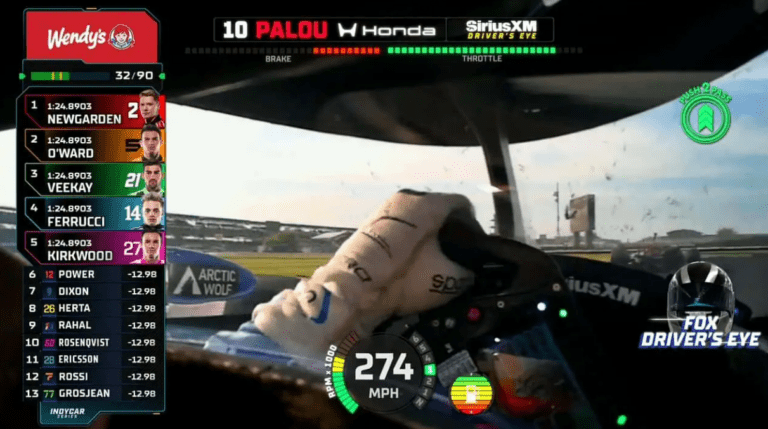
A true indicator that spring is slowly approaching, the first race in the NTT IndyCar Series is this weekend in St. Petersburg, FL. FOX Sports is back in the production and operations cockpit as exclusive broadcaster, and the crew is rolling with technologies that have created engaging viewing experiences, including both the Driver’s Eye camera system and Heads Up Displays (HUDs) close to the grid.
“To say that we wanted to remake the sport on television would be an accurate statement, and tech is a part of that story,” says Mike Davies, EVP, technical and field operations, FOX Sports. “But the biggest factors are the people working in the truck, our FOX ethos of servicing the fan, and, more so, the fact that everybody watching and covering the race are race fans as well. We like to think we approach our coverage as fans first.”
This weekend kicks off FOX’s second season of IndyCar coverage and follows the company’s acquisition of a one-third stake in the circuit last summer. There is plenty of investment happening on the live-production side as well with FOX continuing to iterate its philosophy and enhance its technology in Year 2.

“This year,” says Davies, “I think what you’ll see is a continuation of what we did in 2025, where different pieces of tech — and how our producers and directors use them — will become more apparent, more inextricable from the story, and more utilized over time.”
Back in Business: Driver’s Eye Gives Fans a Unique Perspective
One major enhancement that will keep fans entertained every week was prominently featured during FOX Sports’ IndyCar coverage in 2025: the Driver’s Eye micro-camera system. Aside from making a noticeable impact on F1 races throughout the season, the technology was introduced into FOX Sports coverage during the Daytona 500 in 2023.
Similar to many in-car cameras that the network deploys, the POV camera is installed at the driver’s eye level to transmit a real-time video feed of what they’re currently seeing on the track.
Driver’s Eye technology is provided by Racing Force Group, which recently inked a new multi-year agreement with the broadcaster. Given the success of its introduction at selected rounds in 2025, starting this season, the system will be integrated into the broadcast coverage of every event.
“The Driver’s Eye camera is one of the most exciting cameras in all of sports,” says Davies. “If anybody ever doubted that race-car drivers are athletes, they have only to see the dynamic and violent nature of what actually goes on in the seat of a race car. And being in an open cockpit only enhances what we’re looking at. The shot is not meant to look pretty; it’s meant to look shaky, off-angle, and exactly like what the driver sees.”
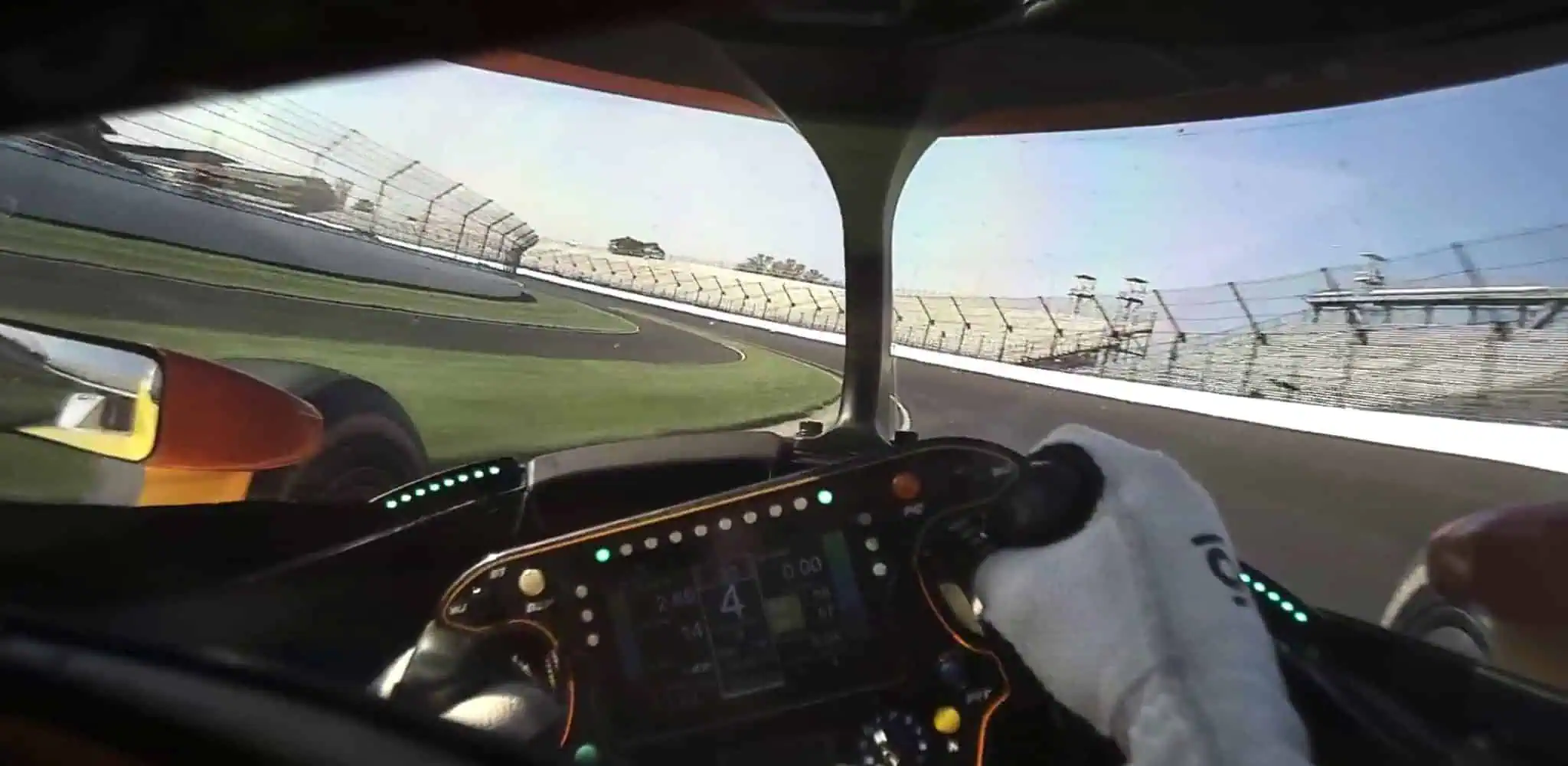
Racing Force Group calls the system the world’s smallest micro camera designed for live broadcasting. Prior to its use at the Indy 500, it was deployed for IndyCar’s 2025 Grand Prix of Long Beach. Fitted into the helmet of Kyle Kirkwood, it delivered a live, first-person view from the cockpit of the race winner. The FIA-homologated system is installed inside the race helmets to offer TV viewers a fully immersive experience from the driver’s exact point of view during the race. The micro camera measures just 9 x 9 mm and weighs only 1.43 grams.
The camera angle has brought a true representation of what it’s like inside the cars flying around the course. From a fan’s point of view, Davies believes, the tech is a major game-changer in the overall story of IndyCar. “We think Driver’s Eye serves as a differentiator,” he notes. “It passes the ‘bar test’ — which is, can you tell what we’re trying to do sitting sound-off at a bar?”
Under the HUD: Heads Up Display Adds New Features
In addition to Driver’s Eye, Fox is expanding its HUD system for in-car cameras. A ton of pertinent information is needed to understand racing strategies or the pressures placed on the shoulders of every driver, including speed, G-force, and throttle management. This digital display, placed virtually via graphics on the car and one of the in-car cameras, updates fans on each driver’s critical statistic during the action.
Inspired by the HUD system used in F1 coverage, the graphic debuted in FOX’s first season of IndyCar coverage and continues to evolve in Year 2. This year, Mobii is taking in all in-car cameras and applying graphics to the video.
According to Zac Fields, SVP, graphic tech/innovation, FOX Sports, FOX has also added tracking to it, which allows the camera to pan around while keeping the HUD in its correct location. Mobii will also be taking in all six Driver’s Eye cameras and applying FOX’s new graphic overlay.
“We spent last year getting it right and figuring out ways to make sure we could get most cars equipped with the HUD,” says Davies. “This year, we’re able to work on enhancing it: namely, how to incorporate it into Driver’s Eye, how to make the conventional HUD dynamic and able to track elements on-screen, and many other features. I think this will be one of those enhancements we keep improving year after year.”
In addition, FOX will bring back the Ghost Car full-screen CG system, a fan favorite last season, to show any car comparisons that production desires. Also returning is the Mario Kart-style in-car Ghost Car setup, which composites a ghosted car within the in-car camera — all provided by SMT.
Eyes in the Sky: Broadcasting in the Golden Age of Drones
Drones will also once again be at the heart of FOX’s IndyCar coverage, and the overhead views have quickly become “an absolute necessity in race coverage,” says Davies.
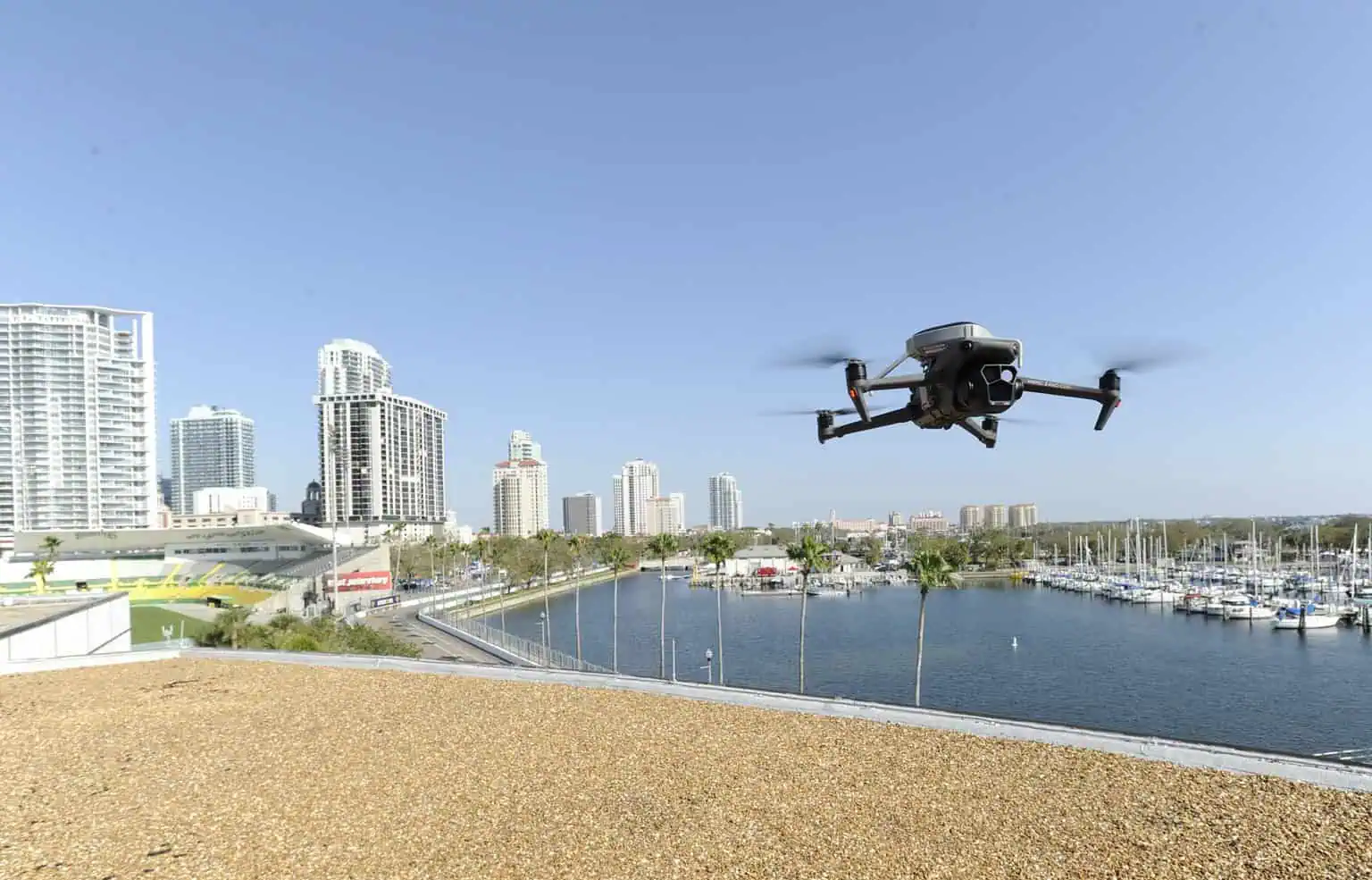
“One of the things I say repeatedly,” he continues, “is that, since broadcast began, we were always covering sports from the outside in. This was good — hard cameras and handheld cameras on the sidelines and in the pits. But, increasingly, our audience demands that we cover the action from the inside out, and I think drones are a good example of this. With their ability to basically go anywhere around the track, drones have earned their seat at the table.”
FOX’s journey with drone coverage accelerated unexpectedly during the pandemic. With empty grandstands and relaxed regulations at NASCAR events, the broadcaster had a rare opportunity to stress-test the technology in live race conditions. What they discovered changed their approach to motorsport production entirely.
“We were able to determine how supremely effective drones were,” Davies recalls. “Now we’ve gotten much better at using them: we use different types of drones for different purposes, and our directors understand how to deploy them effectively. We are truly in a golden age of drone coverage in sports broadcasting.”
At last year’s Indianapolis 500, FOX ran two drones simultaneously — and even that, Davies says, left them wanting more. He notes that drones are particularly effective on street courses, where they’re able to get views unavailable from conventional aerials and ground-based cameras.
“They’re at that wonderful in-between altitude that shows what’s going on strategically and offers an extremely exciting view to boot,” he explains. “Drones are not there just for gimmick anymore; they’re vital parts of the race coverage.”
Besides the scenic pictures, audio is at the core of FOX’s mission. Each car is outfitted with two microphones, and the IndyCar venues are populated with an army of mics to capture the one-of-a-kind sound of a race.
Collaborative Effort: FOX Sports and Trusted Vendors
As with any other major live sports production, the final product is possible only through a relationship with the broadcaster and the long list of vendors supporting their respective workflows. FOX Sports’ presentation of IndyCar is no different, but, internally, it begins at the top.
“Obviously,” says Davies, “it all starts with [CEO] Eric Shanks, whose lifetime love of Indy has been infectious during this whole process. Brad Zager, [president, production and operations/executive producer] provides overall guidance on look and feel along with, of course, producer Pam Miller and director Mitch Riggin.
“And,” Davies continues, “none of this is possible without George Grill, coordinating technical producer, motorsports, an incredible find and talent who takes care of Indy and NASCAR; Matt Battaglia, who heads up internal engineering and operations; and, of course, our incredible crewing, transmission, and production management teams. Eric Foster, Hannah Seaman, and Noah Handstedt run daily production and technical operations.”
Externally, the show is assisted by NEP Specialty Capture (formerly BSI) for wireless and in-car cameras, SMT for the real-time data and GPS tracking used to power on-air graphics, Mobii for HUD integration, Racing Force for Driver’s Eye, CES Power for compound power, and Event-Ready for ancillary office space in the compound.
IMS Productions works with the broadcaster on creating and managing the compound’s infrastructure. The company supplies the management, remote-production units, robotics, and its expert personnel. The team — IMS Productions President Kevin Sublette; Senior Director, Broadcast Operations, Ken Ferguson; and Senior Director, Engineering, Jason King — “make the whole thing run,” according to Davies.
FOX and IMSP also worked with Lumen Technologies to install 10-gig fiber lines at every track to provide the necessary bandwidth for the broadcaster’s growing IndyCar operations and allow more crewmembers to work remotely.
“[IMS Productions] deserves an astonishing amount of credit,” Davies says. “It can’t be easy having a company like FOX Sports come in and rummage through decades of institutional history, but they were as excited as we were and have been tremendous collaborative partners.”
SVG’s Jason Dachman and Mark J. Burns contributed to this story. Read article at sportsvideo.org.