

By: Jason Dachman, Editorial Director, U.S., Sports Video Group
A crew of 1,685 people and 13 control rooms produce nearly every on-air minute from Stamford
Since the ribbon was cut in 2013, NBC Sports’ Stamford, CT, broadcast center has grown and evolved with each passing year. And, every two years, the Olympic Games provide a touchstone for NBC to evaluate just how far the facility has come. Now, as the broadcaster enters the homestretch of the 2026 Milan Cortina Games, it has never been more apparent that Stamford is the undisputed axis on which its Olympic-production world turns.
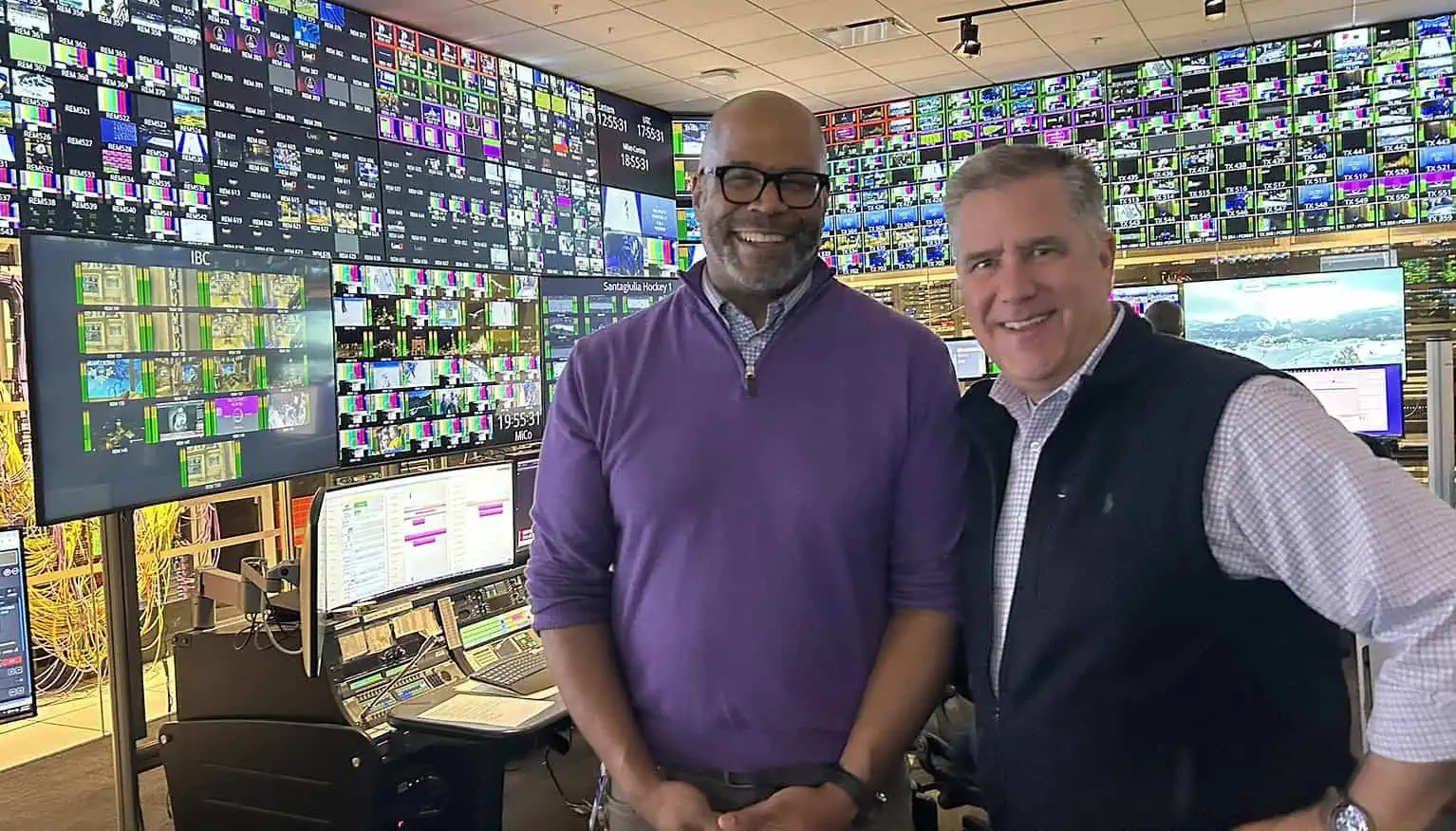
“Stamford is the anchor point of the whole show for these Games,” says Darryl Jefferson, SVP, engineering and technology, NBC Sports, who is in Stamford for the duration of the Games. “At this point, every minute of finished [on-air] product comes out of this building with the exception of figure skating, which is produced in country.
“It has been a true sea change for us from where we were before this building existed,” he continues. “While we’ve been edging towards this reality for a long while and certainly pushed a lot more to [Stamford] for Beijing [2022] and Paris [2024], we’ve taken it to the next level for [Milan Cortina] and are now fully committed to essentially running everything out of here.”
With 1,685 people working out of Stamford and nearly all the 3,400 hours of content produced across NBC, Peacock, USA, and CNBC running through Stamford in some fashion, the at-home operation has never been bigger. And NBC is already seeing the dividends from the effort in sky-high ratings thus far for Milan Cortina 2026.
“The sheer volume [of content] that we deal with here in Stamford during an Olympics is hard to fathom,” says Tim Canary, SVP, engineering, NBC Sports. “There’s very little downtime to fix anything if something goes down so it’s all about preparation and making sure our people and our vendors know now how to deal with every possible situation. We can’t ever find ourselves waiting because the Olympics never stop.”
Big Changes: 1080p HDR, Flip to 50Hz, VERSANT Spinoff
As part of a multi-year, multi-stage effort, NBC completed transition of the entire facility to 1080p HDR last fall, and those labors are evident in these Games. In addition, NBC opted to shift nearly the entire facility from 60 Hz to 50 Hz during the Olympics because Stamford would be ingesting 50-Hz feeds from Olympic Broadcast Services (OBS). Also, all Olympics content is being produced with 10 channels to enable Dolby Atmos for distribution.
These three moves have allowed NBC to streamline operations and avoid the labyrinth of mixed formats that often plagued previous Olympic efforts.
“It just wasn’t sustainable for us to be constantly translating between different formats — whether HDR and SDR, 50 Hz and 60 Hz, or 5.1 stereo and Atmos,” says Jefferson. “When you start with a higher mezzanine, like 1080p and HDR and 10 channels of audio across the board, it normalizes everything. That means fewer complications and makes for, on a macro level, a much smoother plant with much easier handoffs.”
Adding yet one more major challenge ahead of the Games, NBCUniversal officially spun off VERSANT, which operates the cable networks, at the beginning of the year. This meant that the team in Stamford had to build out a Network Operations Center and Media Operations Center to replace the previous facilities in Englewood Cliffs, NJ, which moved to VERSANT control as part of the deal. The NOC and MOC join the Digital Operation Center (DNOC), which was erected in Stamford prior to Paris 2024 and manages the onslaught of live streams distributed to Peacock and other NBCU digital platforms.
Legendary February: Playing Tetris With People and Resources
With Legendary February in full swing, nearly all operations for Super Bowl LX in Santa Clara, CA, and NBA All-Star in Los Angeles were moved onsite. At another time, Stamford would likely have played a vital role in both productions, but, with the plant moving to 50 Hz, NBC opted for onsite production for non-Olympics operations this month. The lone exceptions are the Golf Channel PCR and the NBA on NBC edit operation, both of which remain in Stamford running in 60 Hz.
In addition, NBC temporarily shifted all its NBA and Premier League studio operations from Stamford to 30 Rock to make room for its gargantuan Olympics needs.
“The people planning was also very challenging this month,” says Canary. “We had to decide who was going to be at the Super Bowl, at NBA All-Star, and here in Stamford. And there were several instances when someone needed to be in multiple spots at once, and obviously that’s not possible. So we had to divide and conquer, and, if we were thin in some areas, we would beef it up with other internal and vendor support.”
In addition to enhancing the Stamford infrastructure, NBC also made a concerted effort to enhance its communication workflows between the Stateside crew and the in-country crew. NBC Olympics Coordinating Director Mike Sheehan spearheaded the process, knowing that communication would be more important than ever for the Milan Cortino Games, given not only a busy February but the widely dispersed venue clusters in Italy (where it would take roughly 18 hours to visit every venue one after the other).
“Compared to Beijing and Paris, we’ve made an effort to refine communication process between our people in country and their counterparts here in Stamford,” says Canary. “When you’re dealing with this many venues spread across the different [venue clusters in Italy], that’s more important than ever. We made sure that we had specific processes in place, and that has made a world of difference.”
In Stamford: Studios, Primary PCRs, Micro Control Rooms
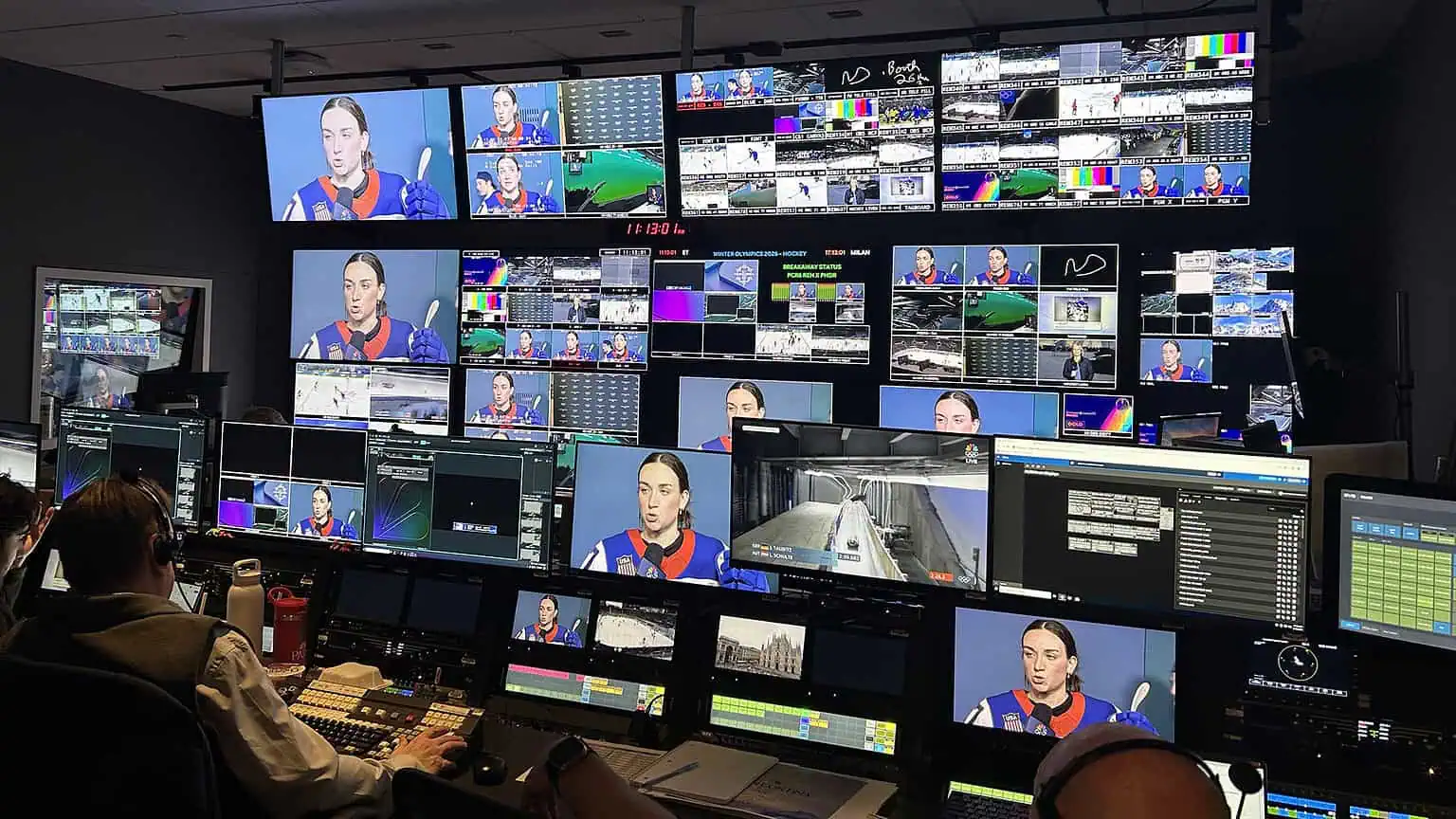
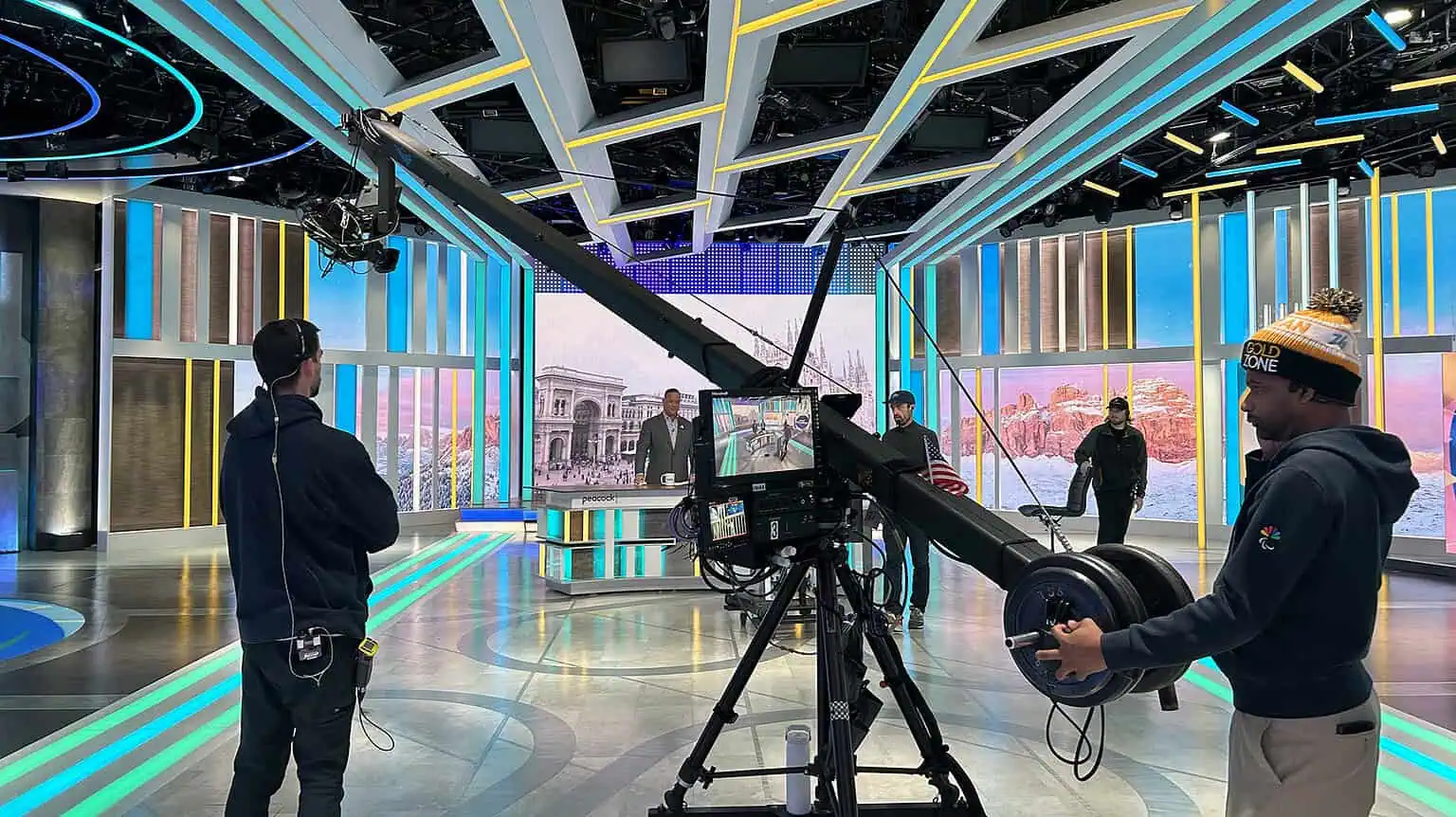
NBC is leveraging its abundance of studios and production-control rooms (PCRs) to produce more events at home than for any prior Games, deploying six control rooms and two mobile units parked at the loading dock. In addition, three studios and five control rooms are dedicated to the shows airing in NBC primetime and daytime, on USA and CNBC, and on Gold Zone on Peacock.
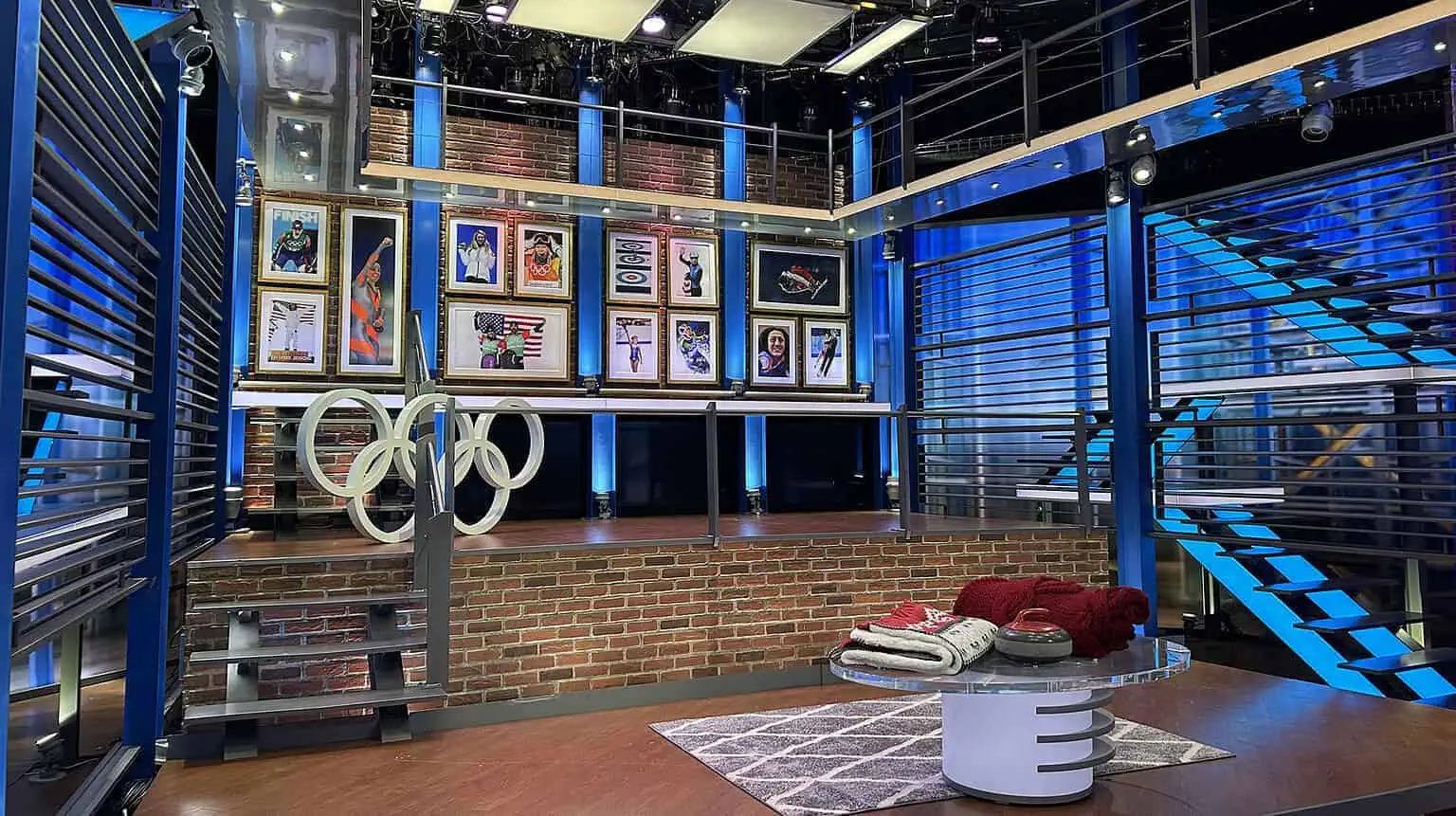
The control rooms are dedicated to specific coverage: PCR2 to NBC primetime, PCR3 to USA Network, PCR 4 to NBC daytime, PCR12 to Gold Zone on Peacock, and PCR13 to CBNC. The remaining PCRs are handling individual sports: PCR6 Hockey, PCR9 Speed Skating, PCR 10 Curling, PCR11 Alpine, and PCR14 Sliding.
NEP mobile units onsite are NCP 11 for Aerials and Moguls (and serving as NBC’s business-resumption truck should the building suffer a catastrophic failure), ND6 for Snow Park, and ND7 as an additional support truck. NBC has also two digital-control rooms (DCRs) handling enhanced productions for Peacock’s Ringside Live and Multiview.

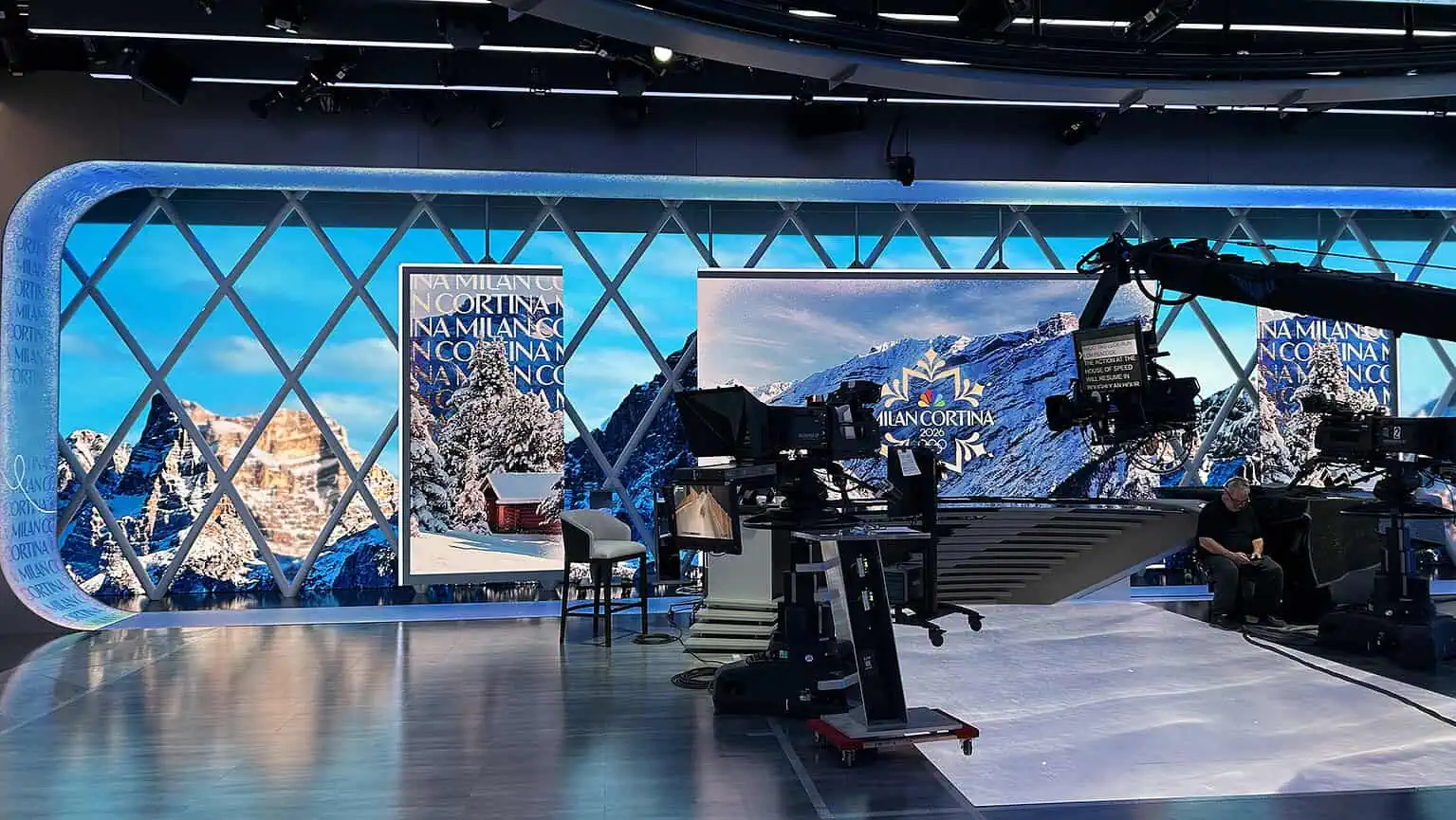
The studios also have their assignments. Studio 1 (recently transformed into the NBA on NBC studio) is serving the USA 4K HDR feed; Studio 2, CNBC’s broadcasts (primarily curling and hockey); and Studio 3 (typically home to Premier League and Football Night in America), Gold Zone.
“The studio operations for this year’s Winter Games have been running exceptionally well,” says Myles Rich, director, studio tech ops/facilities scheduling, NBC Sports.“ We have been planning for the Games for over a year and have assembled a great team. The increase in REMI productions in Stamford over the past five years helped prepare us for the increase in at-home programming.”
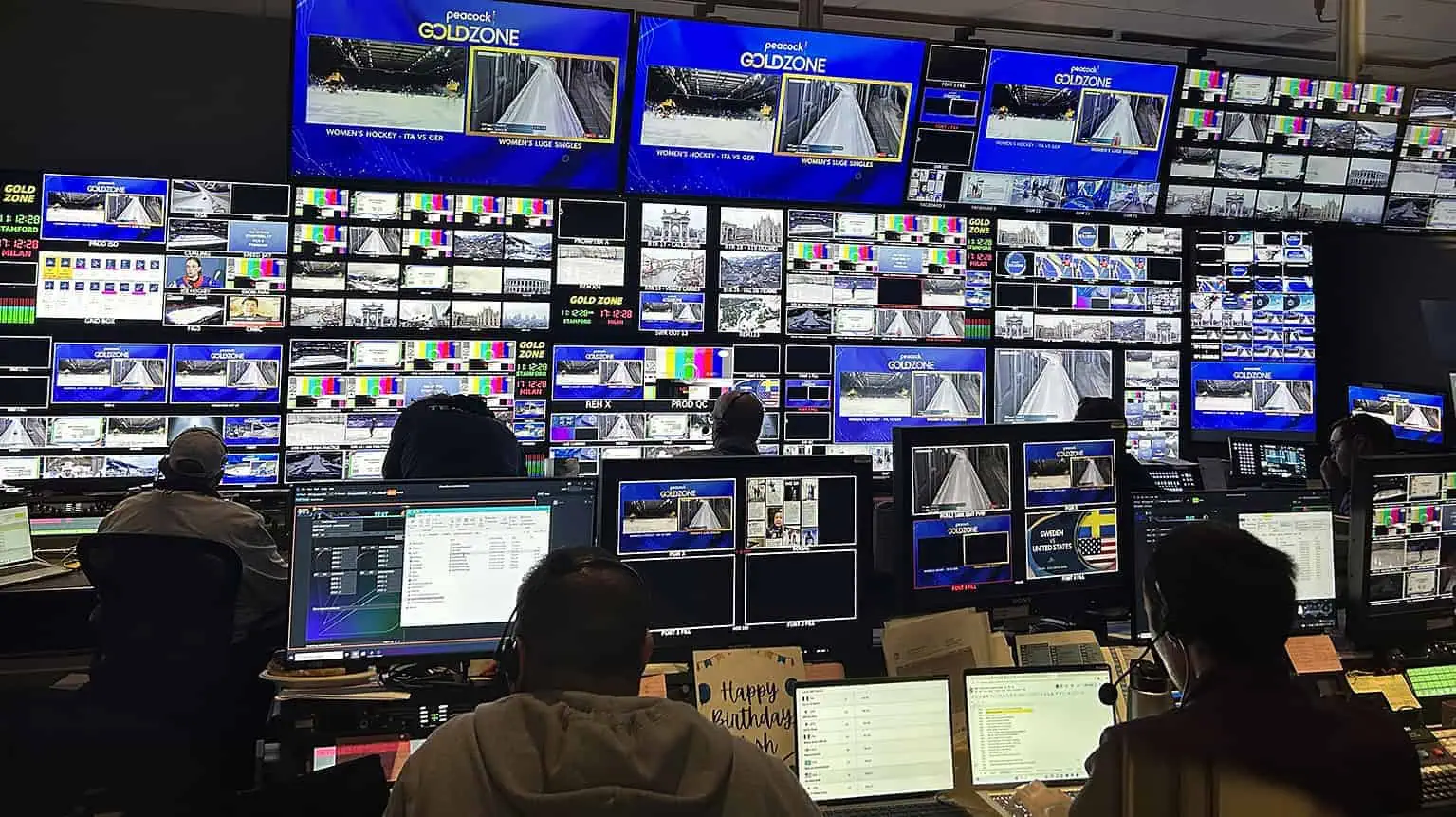
Between Paris 2024 and Milan Cortina 2026, NBC built four “micro control rooms” (PCRs 9, 10, 12, and 13) primarily to serve its Big Ten college-basketball package. The identical PCRs have a smaller footprint than traditional control rooms and offer streamlined workflow for high-volume properties, like college hoops. They are built around Sony MLS-X1 switchers with 64 routable inputs and Calrec Argo 24-channel audio consoles (recently upgraded from Calrec Brio) and are typically paired with two EVS replay systems.
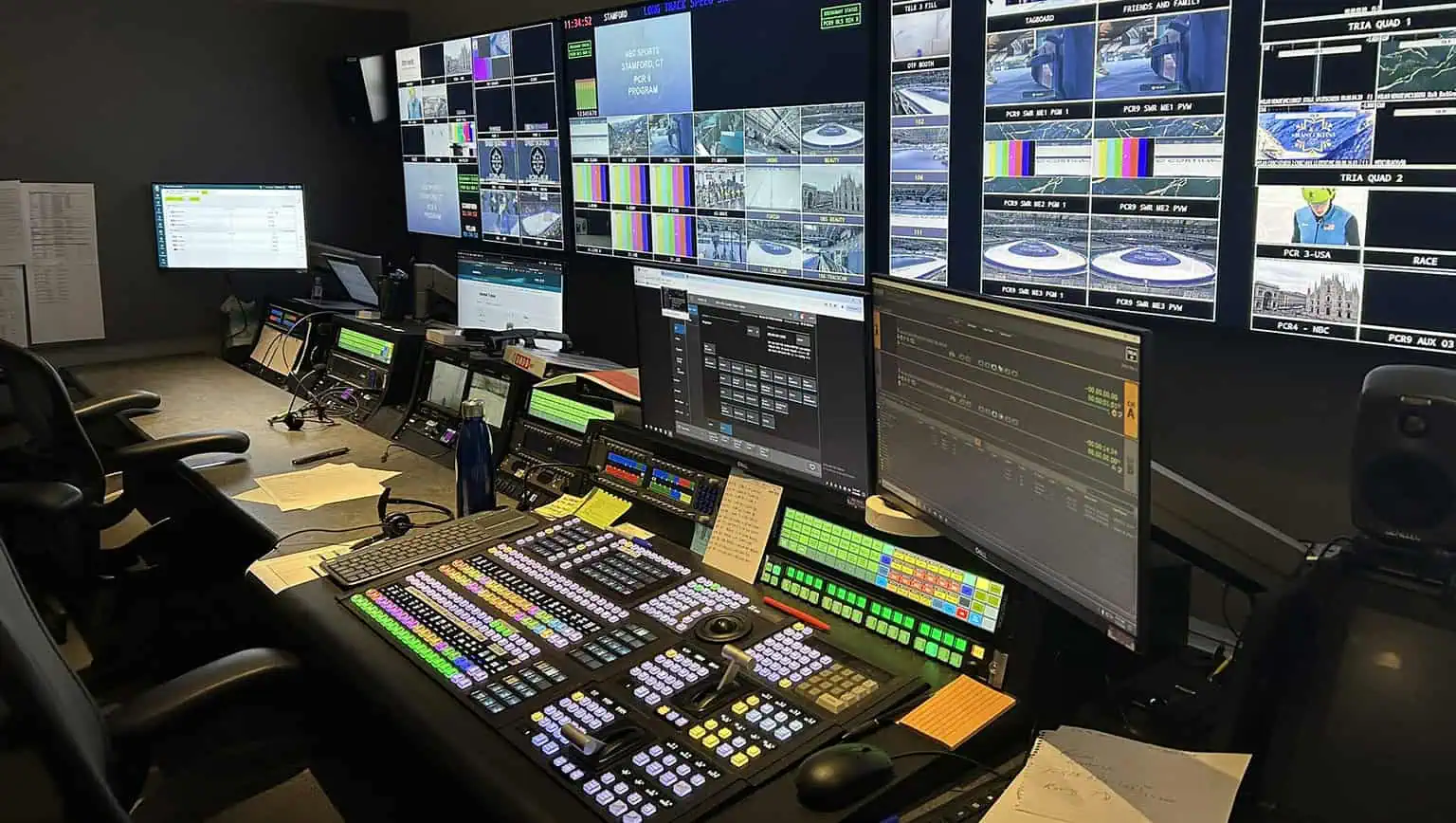
“We built these micro control rooms coming off the Paris Olympics as we took on college basketball,” says Kevin Callahan, VP, system engineering, NBC Sports, “and they’ve become indirectly useful for our mid-tier REMI shows. All four of them are highly capable to the level that our big rooms were at a few years ago but with a much smaller footprint.
“For Paris,” he continues, “we had to spin up five temporary control rooms, but, since then, we’ve built out all these micro control rooms and finished our ST 2110 transition with PCR6 and across the board for command and control. There is no longer a need to create those temporary facilities.”
Flex Rooms: Versatile Workstations for Replay, Graphics, Next-Gen Tech
A total off 35 flex rooms — versatile KVM-enabled workstations capable of serving a variety of positions — also play a key role in the Stamford machine.
The ultra-versatile glass-covered rooms have become integral to NBC Sports operations not just during the Olympics but year-round. As a result, a large row of 22 additional flex rooms was built in an area that previously housed logging stations (whose function has largely been automated over the past two years).
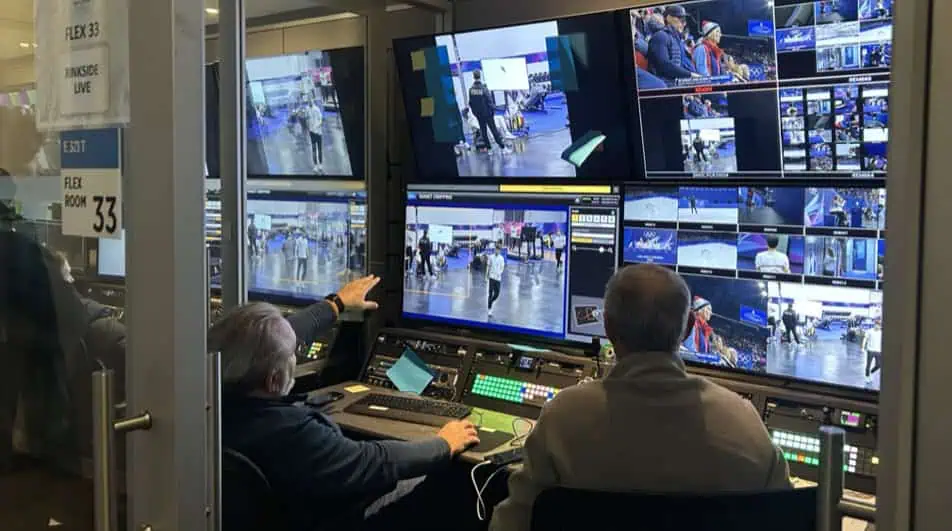
“The flex rooms have been a game-changer for us,” notes Callahan. “After the Paris Games, we expanded from 13 to 35 flex-room spaces. As the name implies, we use these for everything from EVS playback to Chyron, AR, and Ross Piero to utility workspace. Routing, multiview, comms, audio monitoring, and lots of connectivity make for spaces we can easily use for many purposes.”
Off-Tube Factory: Remote Commentary Operation Hits Its Stride
NBC’s Off-Tube Factory — a hub for Olympics audio — is also back, with announcers calling action remotely from 17 booths in Stamford (versus 28 for Paris). It offers three levels of capabilities: standard booths (with a single announcer), graphics-enhanced booths (which adds a producer to handle graphics and other tasks), and four super booths (featuring a Fingerworks telestration system and a remotely controlled Sony FR7 PTZ camera, allowing the talent to appear on-screen).
NBC has also dedicated three booths to audio description for NBC Primetime, NBC Daytime, and Gold Zone broadcasts.
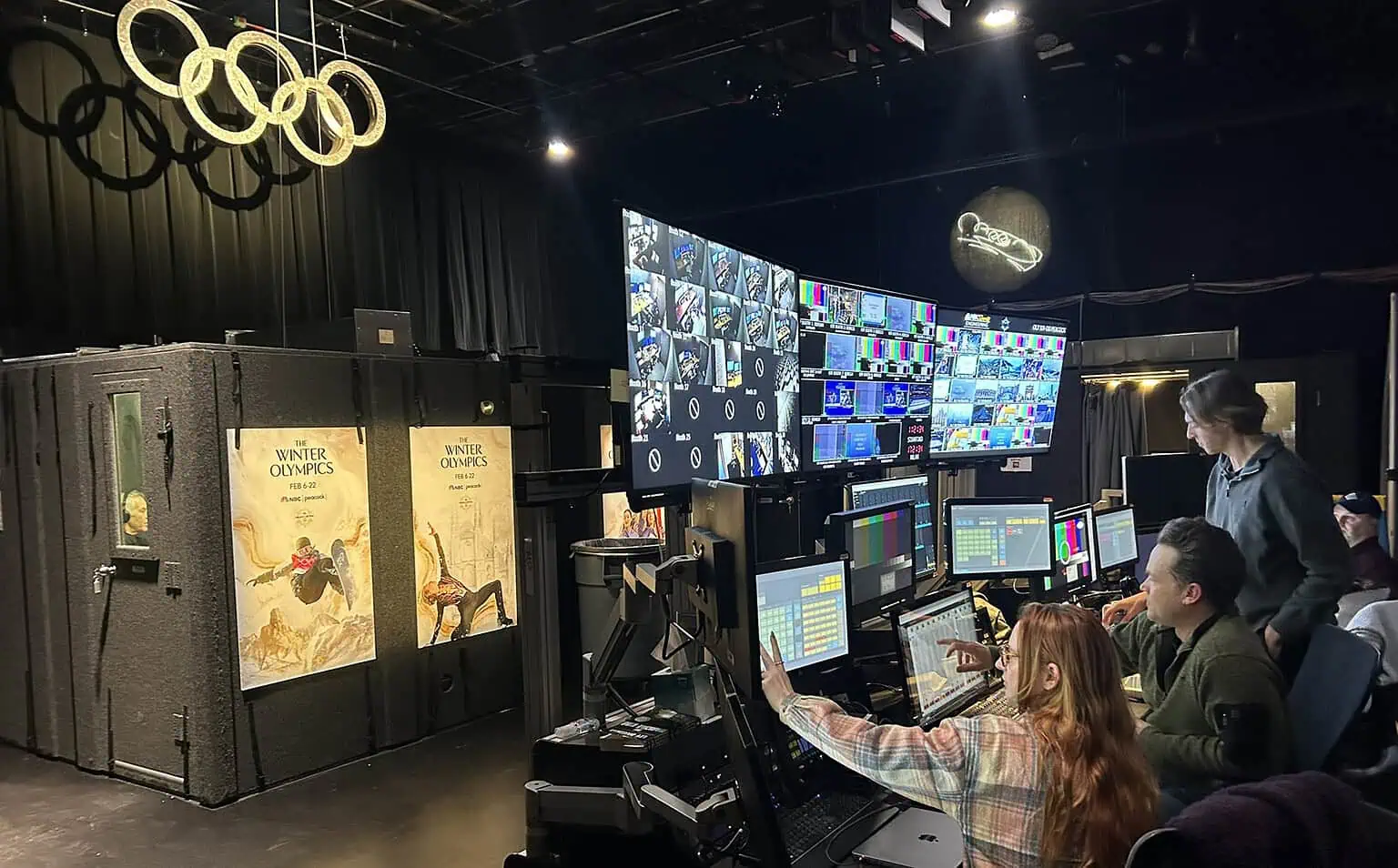
“We have continued to build on the success of the recent AoIP redesign with a strong emphasis on scalability and flexibility,” says Michael DiCrescenzo, director, audio and production workflow, NBC Sports. “The GUI-based, headless Calrec console integrates seamlessly into Stamford’s larger audio fabric, enabling the simultaneous voicing of up to 32 individual events.”
A total of 96 announcer consoles are supported by two audio operators and a team of A2s, who manage the routing of all feeds to and from each announce booth. The signals are combined with event audio, mixed, and prepared for air.
“The dynamic nature of the Olympic Games,” says DiCrescenzo, “requires the ability to seamlessly connect and mix announcers whether they are located in Stamford, Milan, or anywhere else in the world. The Off Tube Factory allows us to ensure consistent quality and flexibility regardless of the production needs.”
With the Winter Olympics fielding fewer events than the Summer Games, not all Off-Tube booths are in use. No resource goes to waste in Stamford, however; NBC is using the unmanned off-tube booths as additional edit suites and EVS operator positions.
Beyond Live: EVS Ingest, Edit Suites, Highlights Factory, Command Center
Stamford is equipped with 40 EVS XT-Via servers, and the central ingest team is in charge, bringing in thousands of hours of content from OBS and a variety of other sources.
“For this Olympics, we streamlined EVS, edit, and highlights workflows to ensure faster content movement from venue to IBC to Stamford through standardized routing and tighter system integration,” says Stacey Georgiou, VP, Production engineering, NBC Sports. “The result was quicker turnaround on near-live and digital content, improved collaboration, and a more efficient, scalable operation overall.”

Among the key changes, NBC streamlined ingest and playback paths to ensure that content moved more seamlessly with minimal manual intervention. Standardized routing, shared storage alignment, and tighter EVS-to-edit integration allowed editors to access content faster and with greater reliability.
Fifty edit suites house NBC’s army of editors producing high-end Olympics segments, while more than 75 “soft edit” workstations allow editors to produce additional pieces. The edit team deploys an eight-frame Avid F5 storage system, which was installed last year as part of a facility-wide storage upgrade to accommodate the move to 1080p HDR.
“After Paris,” says Rob McKnight, director, media management and operations, NBC Sports, “we needed to right-size our Avid Workgroup due to the volume of content needing to record.”
The increase in storage capacity for NBC’s Olympics media-asset management (MAM) has allowed the team in Stamford to keep up with a daily media flow of more than 50 TB, all in XAVC Class 100 — with the added ability to keep it all online for the duration of the Games.
Signiant continues to serve as the glue in sending content not only to venues in Milan and Stamford but also to NBC’s operations at the Super Bowl and NBA All-Star Game out west. Midway through the Games, NBC has already transferred more than 200 TB of content, including more than 300 high-end camera shoots (a mix of RED, ARRI, and Sony).
NBC has also doubled down on use of Latakoo, a cloud-based MAM workflow solution, for acquiring content via phones. This has allowed the broadcaster to automate directly to its EVS or edit workgroups for broadcast needs, while also providing the content necessary for social-media teams working in country, in Stamford, and remotely. To date, Stamford has received more than 2,000 assets via Latakoo.
“Really,” adds McKnight, “the key to making all of this work is the talented group of people we’re surrounded with in Stamford. Without them, this simply wouldn’t work.”
Highlights Factory is also back, with 50-60 people producing clips and packages for Peacock and for NBC Sports’ digital/social platforms. NBC is also using WSC Sports and other AI-powered tools to help create and curate this content.
Additionally, NBC has emphasized clear role definition between operators, editors, and Highlights Factory, reducing duplication of effort and improving turnaround times for near-live and digital content. Enhanced communication between EVS and production teams helped prioritize key moments in real time, allowing NBC to deliver highlight packages more efficiently than in previous Games.
“Overall, this year’s operation benefited from stronger pre-Games planning, cleaner system design, and refined remote support models,” says Georgiou, “all of which contributed to faster content delivery, fewer workflow interruptions, and a more scalable approach to peak-event coverage.”
The broadcaster has spun up a content-command center, which aggregates content from an abundance of sources — OBS feeds, ENG content, third-party feeds — and identifies key content that can be pushed out to the rest of the NBC Olympics content operation.
“When you think about it,” says Jefferson, “OBS and other outlets are creating thousands and thousands of hours, and a lot of that ends up getting missed. This team is focused on finding the best of the best from everything that’s coming into [Stamford].”
Routing and BOC: The Heart and Connective Tissue of Stamford
At the core of the entire Stamford operation is the Cisco/Grass Valley ST 2110 routing system with an EVS Cerebrum control overlay, handling 30,000 routes at its peak. All switchers (five Sony XVS-9000’s, two XVS-8000’s, and four MLX-X1’s) from Stamford PCRs feed into this routing infrastructure.
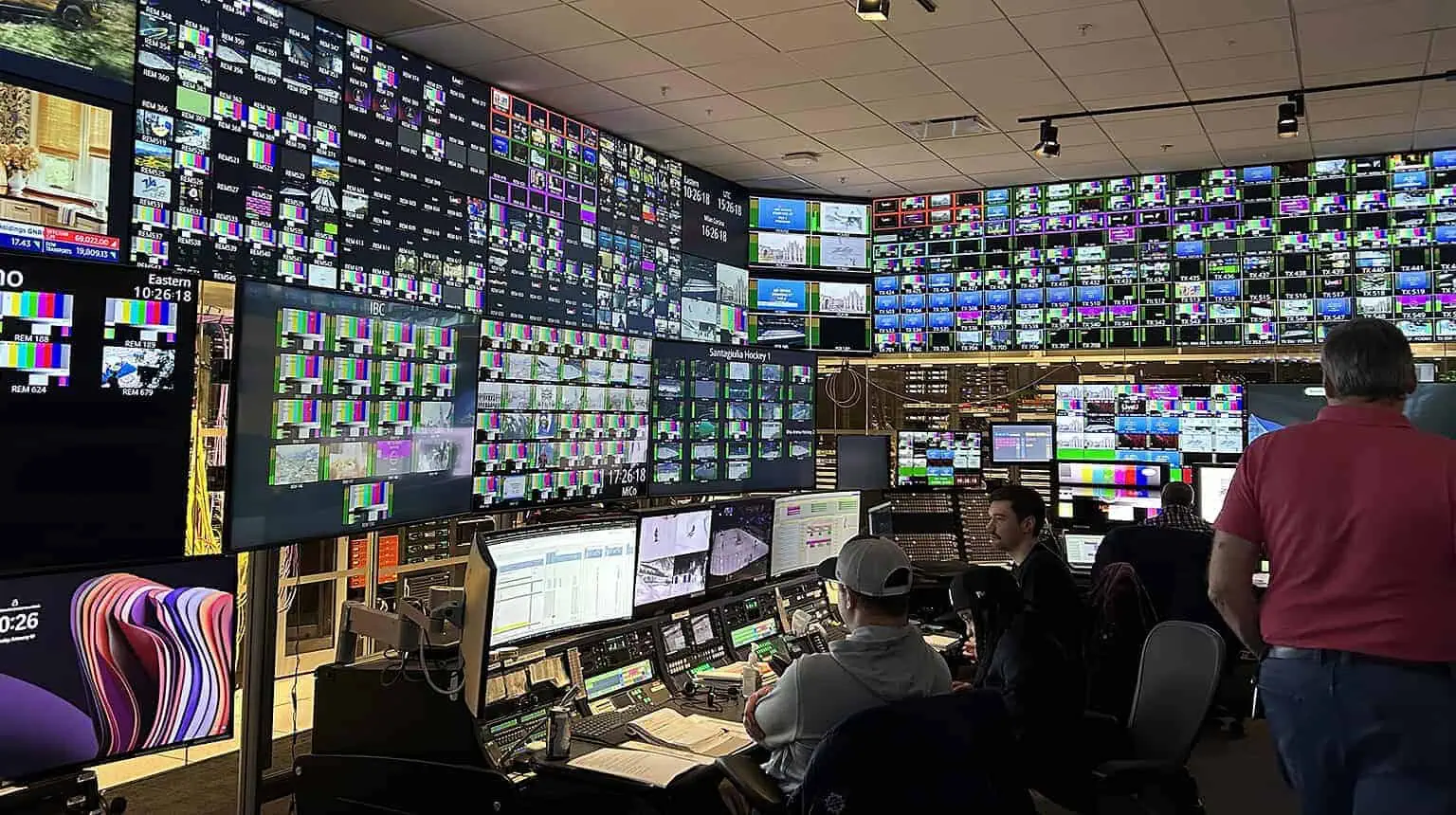
“As the company has committed to more properties over time,” Jefferson notes, “it has obviously grown the breadth and volume of what we do here. Every time we add an NBA or MLB or college football or college basketball, we need to adjust and grow the facility accordingly. We couldn’t have done any of this pre-IP, and we also have had to consider every aspect of the operation from storage to encoding and everything else.”
Of course, no area in Stamford is busier than the Broadcast Operations Center, which manages hundreds of contribution paths throughout the Olympic Games.
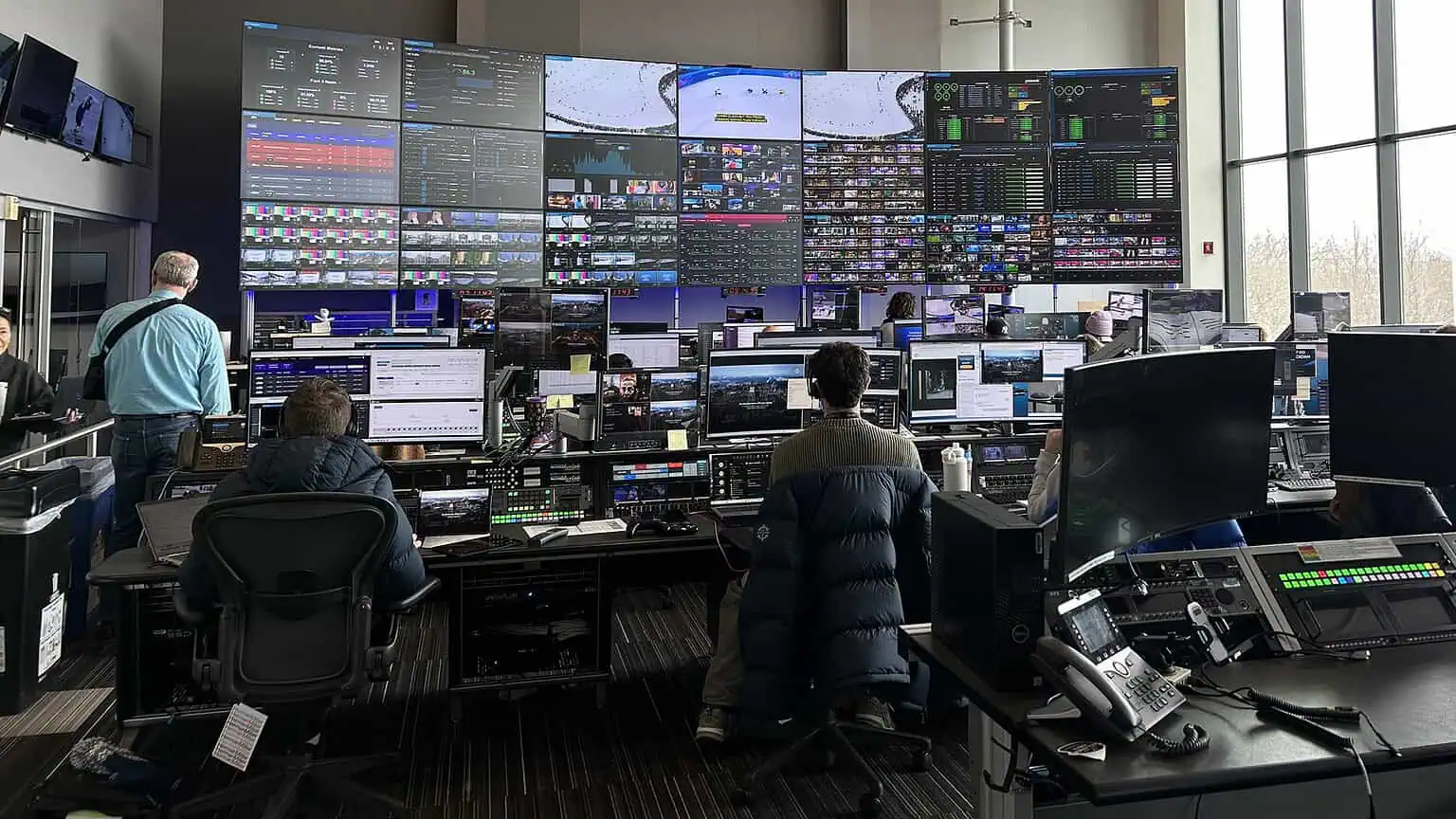
For signal contribution, Stamford maintains connectivity to the Milan IBC operation via four diverse 100GbE circuits provided through AT&T. A whopping 492 discrete contribution paths traverse the transatlantic infrastructure between Stamford and the Milan Cortina venue clusters, a 39% increase over the 355 paths deployed for Paris 2024. The Milan Cortina production comprises 216 JPEG XS, 210 HEVC/H.265, 12 J2K, and 54 LiveU encoded feeds. When factoring in the U.S. contribution, interconnecting NBCU’s domestic facilities, the total path count exceeds 500.
“I think the big change [for Milan Cortina 2026],” says Ian Dawes-Kuchta, VP, broadcast and transmission operations, NBC Sports, “is that we’re doing more HEVC on the Olympics than we’ve ever done before. We did a lot more JPEG XS on previous Olympics, but that just wasn’t possible this time around due to the locations of the venues and available bandwidth. We partnered with Appear on their ULL HEVC solution, and it allowed us to do more paths and bring bigger [productions from] venues back here to Stamford. There haven’t been any big latency issues, we were able to add phase-aligned super-slo-mo splits, and the production team has been happy with it.”
Vendors Flock to Stamford: Where Collaboration and Innovation Meet
NBC has once again welcomed its army of vendors to the friendly confines of Stamford not to only provide support but to test out new products and features in their technology. Onsite providing support and contributing to the show are Amazon, Appear, Aggreko, Audio-Technica, Avid, Blackwalnut, Calrec, Canon, Chyron, Cisco, Cyradis Technology, EVS, FOR-A, Google Cloud, Grass Valley, Imagine Communications, Riedel Communications, RTS Telex, Ross Video, Signiant, SMT, Sony, Spectra Logic, Telestream, and TGI Sport.
“It’s definitely a two-way, mutually beneficial relationship,” says Callahan, “We benefit from having them here to support us, and they get to see how their systems are used in the real world at the huge volume we have here. They can talk to the operators firsthand and get user feedback that they incorporate later. It’s a really good relationship that benefits both of us.”
NBC had also rolled up a trailer at the truck dock to serve the arsenal of data-visualization and on-screen enhancements featured in its Milan Cortina 2026 coverage. Those enhancements include Omega Stop Motion, Skeletal Analysis, and Skiing “Ghosting” technology; Fingerworks telestration; Ross Video AR graphics; SMT heart-rate monitoring, scorebug, and data visualization; Tagboard social-media integration; and TGI virtual dasherboards and on-ice graphics. The broadcaster is also taking the team radio feeds, drone feed (provided by XD Motion), and a variety of other enhancements from OBS and integrating these features into the coverage.
“The beauty of the Olympics,” says Canary, “is that we get to try all these new technologies because there’s so much excitement and momentum around the Games. Vendors want us to try new things and are willing to work with us to make sure we get what we need from their technology. Sometimes, we end up moving forward and using it, and sometimes we don’t, but no matter what happens, the Olympics allows us to find and experiment with new technologies.”
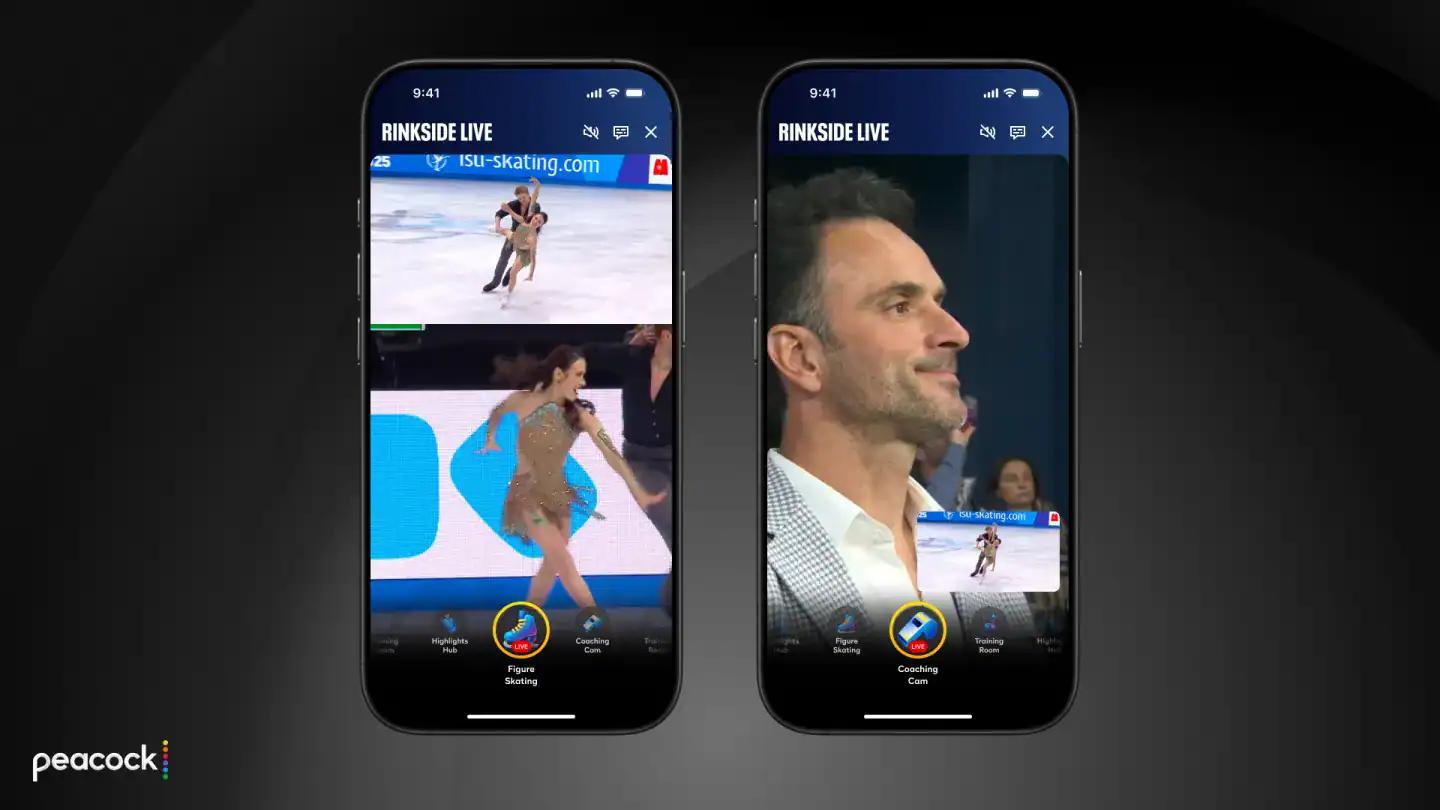
One of the most interesting new technologies deployed for Milan Cortina 2026 is the AiDi AI-based 9:16 real-time cropping solution (provided by Nippon TV and FOR-A) supporting Peacock’s Rinkside Live streaming experience. Using highly intuitive operation, AiDi delivers automatic 9:16 cropping with auto-tracking, allowing NBC to easily reformat its 16:9 live coverage for 9:16 mobile viewers.
“For Paris, we created a lot of 9:16 edited content for TikTok, but it was extremely labor-intensive,” Canary explains. “We never found a quality solution for live 9:16 content. When we saw this solution from FOR-A, we were absolutely blown away. We worked with them to refine the technology and add a few features for our needs, and now we think this is going to be a game-changer for enabling 9:16 video, which is a massive initiative for the entire company.”
Right Around the Corner: 888 Days Until LA28
Although the Milan Cortina Closing Ceremony is still a week away, NBC has already begun planning in earnest for the 2028 Los Angeles Summer Games.
“We know LA28 is going to be very different.” says Jefferson. “First of all, it will be 100% live, which is fundamentally different from the back-to-back European situation. Each of these Olympics teaches us a lesson, intentionally or otherwise, so we will take the learnings from this one and carry those over to LA28.”
Although plans are very much still in their infancy, he notes, NBC plans to rely more on onsite facilities at L.A.’s larger venues, as well as on NBCUniversal’s sizeable presence in the Los Angeles area.
Even so, he adds, Stamford will continue to be key. “I’m confident that [Stamford] will also continue to play a big role in everything we do for LA28.”
Jefferson, currently working his 10th Olympics at NBC, struggles to articulate his pride in the team’s accomplishments. The turnaround between a Summer Olympics Closing Ceremony and a Winter Olympics Opening Ceremony is “remarkably short,” and the effort was made even more challenging when half the team was dispatched to the West Coast for Super Bowl and NBA All-Star coverage.
“We haven’t seen an effort like this in a single month ever in this business — at least not that I’ve seen,” he says. “Yet, somehow, we’ve managed to pull it off. It’s a testament not just to hard work but also to the consistency and stamina of this team, putting the work in month after month. This is an unbelievably talented group, and it’s a beautiful and humbling thing to be a part of.”
Canary, a veteran of 14 Olympics, echoes that pride, particularly in watching team members grow from one Games to the next.
“One of the primary goals and the thing I find the most rewarding is seeing that evolution of our key people,” he says. “Every Olympics, we get a chance to see how far people have come [compared with previous Games], and that’s extremely gratifying. I’m incredibly proud of this team, and it’s an honor just to be a part of a group of people like this.”